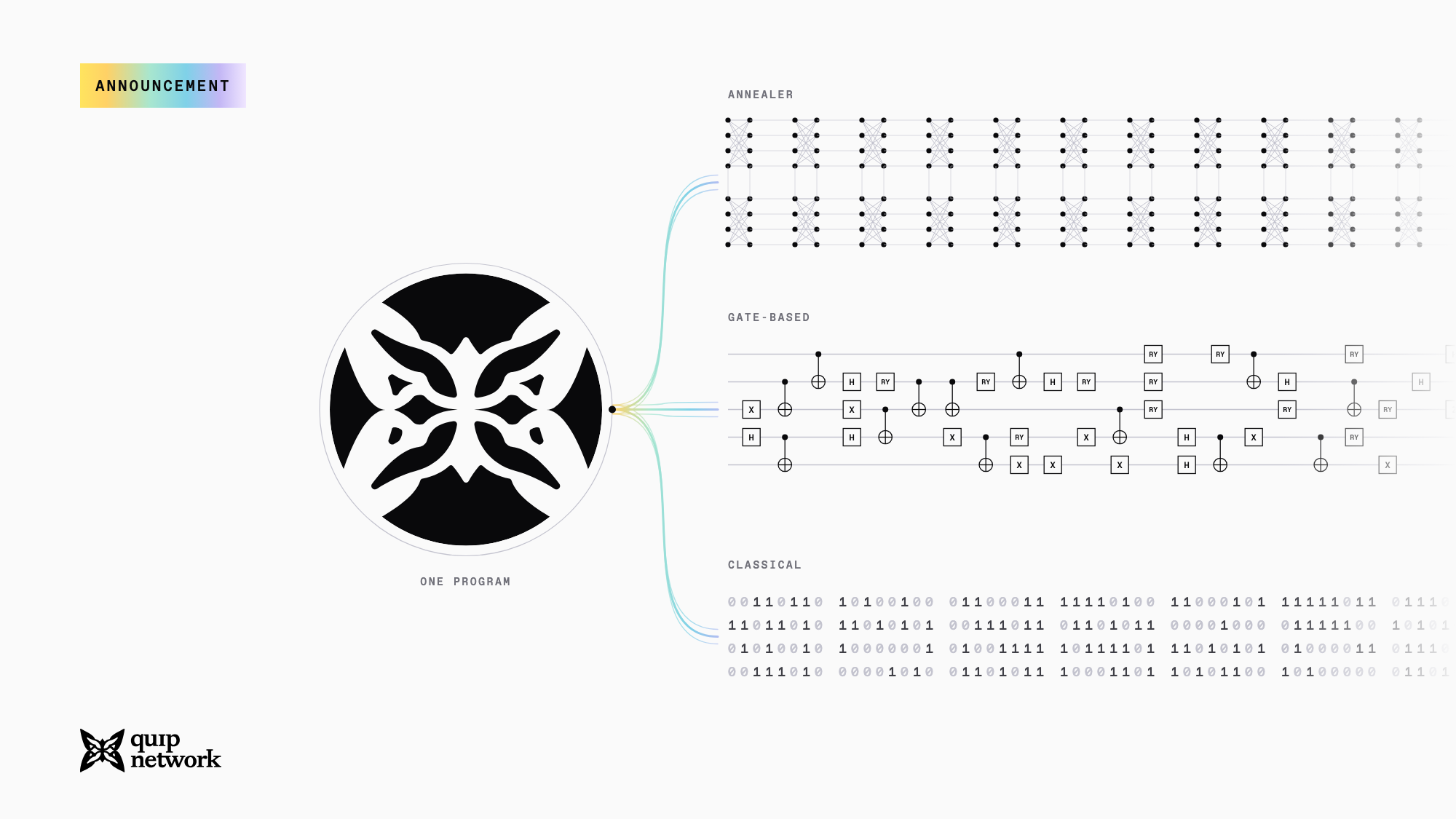

- QVM, the Quip Virtual Machine, is live on the Aglais testnet. Developers write one program in a constraint-based language, and it runs on annealers, gate-based quantum computers, or classical hardware. D-Wave systems are supported from launch, with IonQ support coming.
- Every run is priced in gas, which is set by qubit space, execution time, and entanglement. The maximum cost is quoted before anything executes. Our pay-as-you-go gas-based cost model is the missing piece that unifies and makes predictable pricing across quantum architectures.
- Every result is checked three ways: against a classical simulation, by independent classical benchmarking, and by a cryptographic attestation that ties it to the hardware that produced it.
- In a live demonstration at Quantum.Tech World, the quantum solver matched or beat the classical solver in all 1,930 portfolio optimization races.
Quip Network has launched QVM, the Quip Virtual Machine, along with the first quantum smart contracts. The QVM gives quantum and classical computers one shared instruction set and runtime. It is live today on the Aglais testnet, with support for D-Wave systems, IonQ coming, and free compute credits for new users.
Every quantum computer speaks its own language
The quantum computing industry has a portability problem. IBM's stack is built around Qiskit, Microsoft's around Q#, and Google's around Cirq. None of them share a common program representation or pricing model, and most ask the programmer to think directly in gates and qubit layouts. That is closer to writing assembly than to writing software, and a program written for one stack does not necessarily carry over to the next.
The cost shows up in research labs even before it shows up in budgets. A new student can spend most of a project learning the tooling before they get to the research question.
“Oftentimes, when we put a student on a project, it takes them the whole semester just to learn how to program using the latest quantum paradigms. As we evaluate Quip’s virtual machine, we believe it can speed up student training and give them more time to do real research instead of spending cycles learning a specific programming language or how to program quantum circuits.”
 Dr. Terrence MakProfessor, Department of Data Science & AI, Monash University
Pricing is fragmented too. IBM Quantum's pricing applies only to IBM hardware, and Microsoft's Azure Quantum typically asks for a spend floor of roughly $1,000 before a first circuit can run. Budgeting for quantum work means budgeting for each vendor separately.
What is QVM?
QVM is a unified instruction set and runtime for quantum computation, modeled in the spirit of the Ethereum Virtual Machine. Developers write programs in a single constraint-based language that covers annealers, gate-based quantum systems, and classical hardware, rather than writing for one machine.
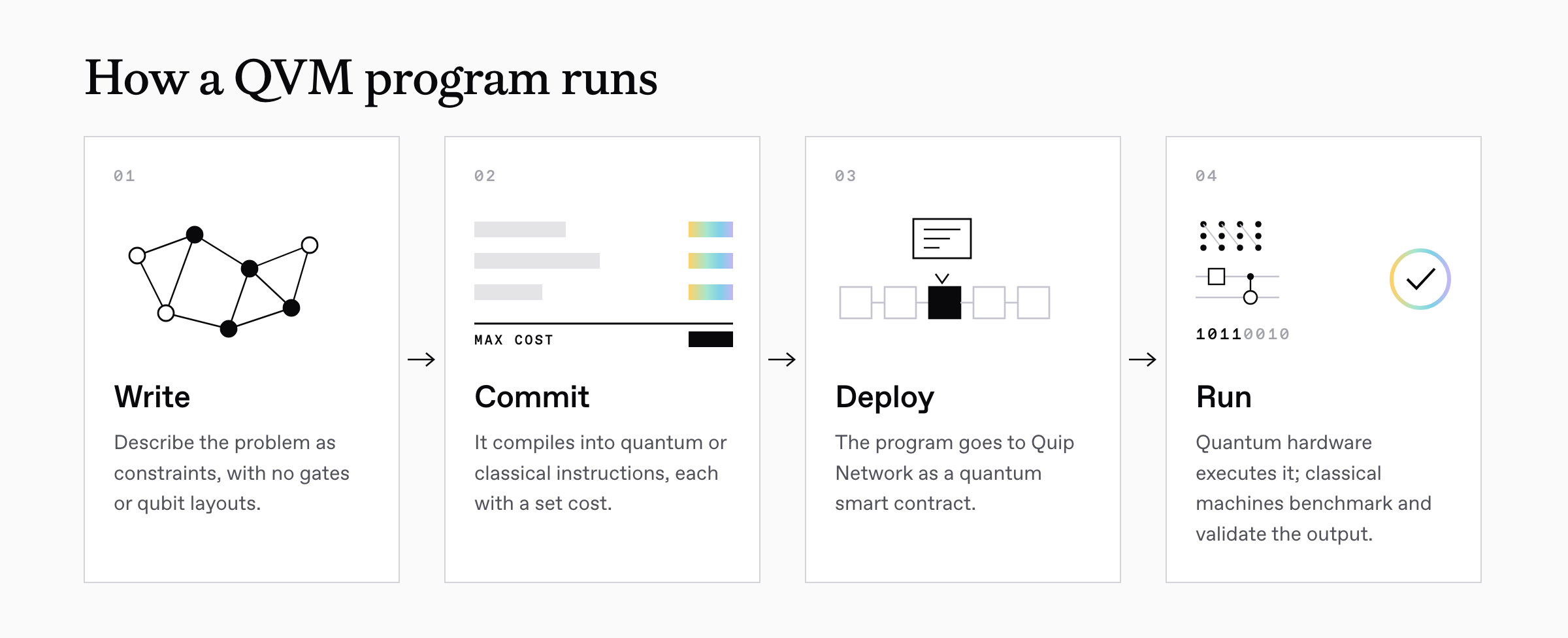
Programs compile into quantum or classical instructions with predetermined costs, deploy to Quip Network, and run on connected quantum computers while classical machines benchmark and validate outputs. Developers can publish programs publicly and earn each time one runs.
“We created the QVM because quantum computing is still fractured between competing instruction sets and assemblers, providing few easy onramps to outsiders. Our virtual machine has three major goals: to unify and clarify pricing of quantum operations and memory across architectures, to distribute hybrid computation across available machines on our network, and to provide an easier abstraction for new quantum programmers that doesn't require them to think directly in quantum gates or qubit layouts. This initial release brings together annealers, gate-based systems, and classical computers under one constraint-based programming language, and marks our first steps toward a unified representation for all of computing.”
 Colton DillionCEO and co-founder, Postquant Labs
Knowing the price before you run
The QVM prices quantum computation in gas. The gas price of a run depends on three things: how much qubit space it needs, execution time, and how much entanglement it uses. Every transaction includes a baseline cost plus an optional tip, and the maximum possible cost is known before execution starts.
The point is predictability. A business can budget for on-demand quantum workloads the way it budgets for cloud compute, without a separate billing model for each vendor. AWS Braket's metered model is the closest existing comparison, but the QVM quotes a spot-style price upfront for each transaction rather than a rate negotiated provider by provider.
“Using a pay-as-you-go ‘gas-based’ cost model is the missing piece that demonstrates quantum computing is commercially viable and practical. When you can predict exactly what a computation will cost before you run it, quantum tests that began as a research experiment become a real tool for engineering because you can quantify exactly how much value it can bring to your products. This is the shift we will be delivering.”
Richard CarbackCTO and co-founder, Postquant LabsHow every result is checked
A result is only useful if you can trust where it came from. Every computation on the network passes through three tiers of verification:
- Classical simulation. Quantum outputs are cross-checked against classical simulations.
- Independent benchmarking. Classical providers benchmark results on their own hardware.
- Cryptographic attestation. Each result is bound to the hardware that produced it.
If a result is disputed, it is settled against the recorded benchmarks rather than against what the operator reports about itself.
Quantum against classical, 1,930 times
At Quantum.Tech World, we ran the QVM in a live demonstration. Around 100 visitors created portfolio optimization problems, and each one was solved head to head by a quantum solver and a classical solver, 1,930 races in all. Results within 0.5% of each other counted as ties.
The quantum solver matched or beat the classical solver in every race.
In every race where the results differed by more than 0.5%, the quantum solver produced the better portfolio, by a median of 2.56%. Both solvers typically returned answers in 0.1 to 0.3 seconds, so the difference was in the quality of the answer rather than the speed.
Who is testing the QVM
Researchers at Monash University, the University of Notre Dame, and Purdue University are testing the QVM for quantum computing research.



“Working with Quip’s QVM can help researchers and students spend less time learning specific quantum programming tools and more time applying quantum methods to practical research problems, including our work on the Lagrangian operator.”
 Shravan Kumar SharmaPhD Candidate, University of Notre Dame
SiC Systems is exploring the QVM for industrial optimization, including applications in AI-driven manufacturing and the design, control and operation of chemical and biological processes.
“At SiC Systems, we face a variety of combinatorial optimization problems, and time is of the essence. We want to explore as many solutions as possible in as short a time as possible. This is particularly important in our physics-informed agent architecture to design, control and operate complex chemical, and biological manufacturing processes. Quip Network’s QVM can help us meet that requirement and better serve our customers.”
 Dr. Soheil MansouriCo-Founder and Chief Science Officer, SiC Systems
How the QVM fits into Quip Network
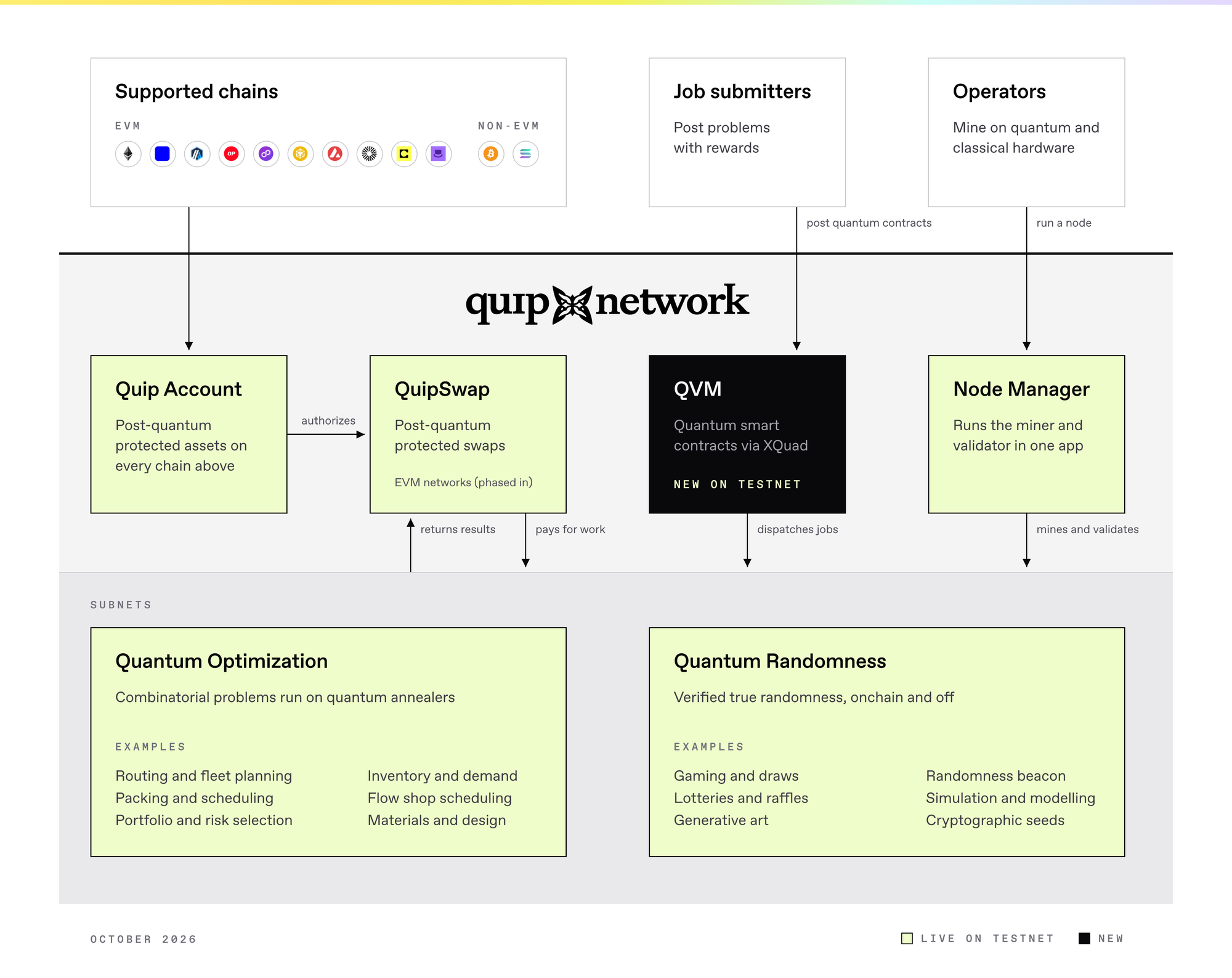
Quip Network is a decentralized marketplace for quantum compute, where hardware providers pool idle capacity and consumers pay for work. It connects the people who need quantum compute with the operators who have it, routes each job to the hardware best suited to solve it, and verifies the result through a trustless compute marketplace.
Each subnet sells a different class of workload: quantum optimization runs most efficiently on annealers, and random circuit sampling gives gate-based machines a paid job. The QVM sits above the subnets as the programming layer, so a developer reaches annealers, gate-based systems, and classical machines through the same language.
QuipSwap, live since September, is the settlement layer for the ecosystem and handles payments end to end with quantum-resistant signatures.
What's live today
- Live now: QVM on the Aglais testnet, with gas-based pricing and free compute credits for new users.
- Supported hardware: D-Wave quantum systems and classical machines, with IonQ coming.
- At mainnet: computation priced in QUIP, with gas still set by qubit space, execution time, and entanglement.
FAQ
What is QVM?
The Quip Virtual Machine is a shared instruction set and runtime for quantum and classical computation. You write a program once in a constraint-based language, and it compiles to instructions for whichever supported hardware runs it.
Do I need to know quantum gates to use QVM?
No. You describe the problem as constraints, and QVM handles the compilation to gates, annealer instructions, or classical code.
What hardware does QVM support?
D-Wave quantum systems at launch, alongside classical computers that run and validate workloads, with IonQ support coming.
How is a QVM run priced?
In gas, set by qubit space, execution time, and entanglement. Each transaction includes a baseline cost plus an optional tip.
Can a run cost more than I expected?
No. The maximum possible cost is quoted before execution, so you know the ceiling before you commit.
How do I know a result is correct?
Every result is cross-checked against classical simulation, benchmarked independently by classical providers, and bound to the hardware that produced it by a cryptographic attestation. Disputes are settled against those recorded benchmarks.
Can I earn from programs I write?
Yes. Programs can be published publicly, and the developer is paid each time one runs.
How does QVM relate to the Ethereum Virtual Machine?
QVM is modeled in spirit after the EVM. Programs deploy to the network as smart contracts and are priced in gas, with the difference that the instructions can run on quantum hardware.
Is QVM free to try?
Yes. New users on the Aglais testnet receive free compute credits.
Links
→ QVM: quip.network/qvm
→ Testnet: aglais.quip.network
→ Use cases: quip.network/use-cases
→ Documentation: developers.quip.network/docs/xquad-toolchain
→ Code: github.com/quipnetwork