

Update, October 2026: Solana support ended in June 2026, and current Quip accounts use SHRINCS signatures. Oak Security’s independent audit was published on September 24, 2026.
- ✓QuipSwap is live: two parties agree a cross-chain swap and settle it directly between their own wallets, with no bridge, no oracle and no wrapped asset in the path. They find each other on a public orderbook.
- ✓Listing an offer locks nothing up. Escrow only happens once a taker commits and the maker funds their side, and one party's claim then releases the other side's key in the same moment.
- ✓Post-quantum protection covers both legs of a swap rather than only the chain you started on.
- ✓The web app is live now, after a formal security audit by Oak Security. The orderbook opens to trading shortly, and the browser extension is coming soon.
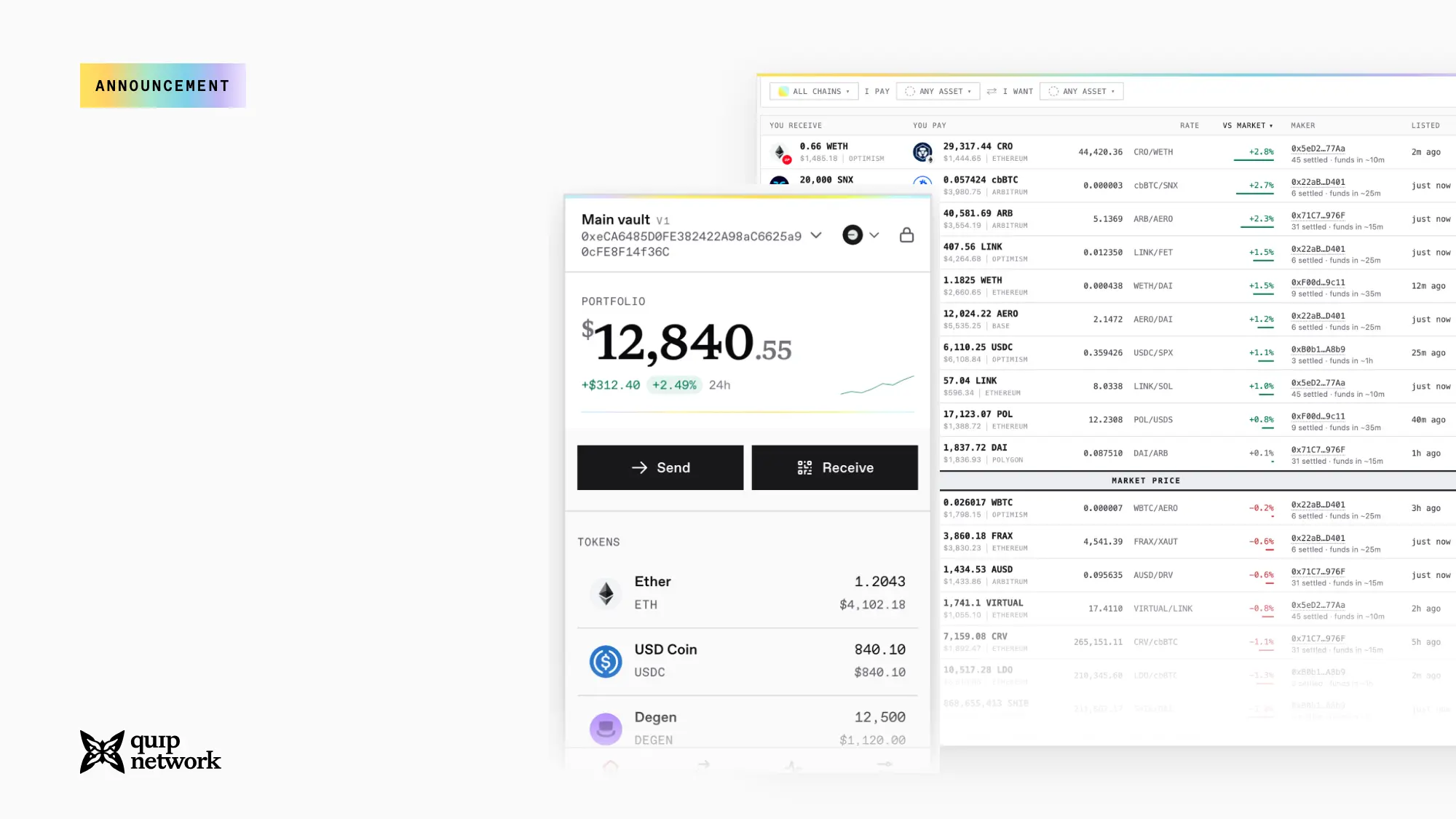
Quip Network has launched QuipSwap, a cross-chain swap protocol where two parties trade directly between their own wallets, with no bridge, no oracle and no wrapped asset anywhere in the path. The two sides find each other on a public orderbook, where a listing is an intent rather than a deposit, so nothing is escrowed until a counterparty takes it and the maker funds their side.
What is QuipSwap
QuipSwap is a bridgeless cross-chain swap protocol. One party names what they will pay and what they want, along with the chain each leg settles on. Another party takes that offer. The two sides then exchange access to each other's side of the trade directly, with nothing holding either leg in between.
A trade made peer to peer still needs a counterparty, so every open offer sits on a public orderbook. Each row carries both legs with the chain each one settles on, the rate, how that rate compares with the market price, the maker's settle history and when the listing expires. A price index alongside the book covers every asset on it, so whether a given offer is a good deal is answerable from the row itself.
Taking an offer needs a Quip account, which is Quip Network's post-quantum wallet: a wallet whose spending authority is committed to a hash-based signature scheme that a quantum computer cannot shortcut.
Why bridges keep breaking
Bridges have been the largest single source of stolen value in decentralized finance. Chainalysis counted thirteen separate attacks on cross-chain bridges in 2022, which between them took more than $2 billion.
Moving an asset from one chain to another has usually meant handing it to something in the middle. A bridge locks the asset on the source chain and mints a claim on the destination chain, and that claim is only worth whatever is still behind the lock. The lock is a contract, guarded by a validator set or a message-relay network, and that combination has produced the six largest thefts on record:
| Bridge exploit | Date | Stolen |
|---|---|---|
| Ronin Bridge | Mar 2022 | $624M |
| Poly Network | Aug 2021 | $612M (returned) |
| BNB Bridge | Oct 2022 | $568M (mostly frozen) |
| Wormhole | Feb 2022 | $326M |
| Kelp DAO | Apr 2026 | $292M |
| Nomad | Aug 2022 | $190M |
Bridge exploits are still producing the largest DeFi losses on record. The biggest single loss of 2026 so far was the Kelp DAO exploit in April, which drained $292 million after attackers compromised the RPC nodes that a cross-chain messaging layer relied on for its quorum.
Bridges solved a real problem with the tools available at the time, and plenty of them run without incident. The risk sits in the trust each one requires, because a bridge adds a set of keys, contracts and relays that neither of the two chains involved needs on its own.
How a swap settles wallet to wallet
A QuipSwap trade runs in four steps, and every one of them happens in the maker's or the taker's own wallet:
"If one party claims their side of the trade, the counterparty immediately receives their claim key too, no take-backs. You can be on any chain and treat it like a P2P swap. No intermediaries holding your funds, no oracles to manipulate, no bridges to hack," said our CEO and co-founder Colton Dillion.
That symmetry removes the need for an intermediary, because no window opens in which one side has claimed while the other waits on a validator set or a relayer to confirm it.
Who holds your funds mid-trade
The four common ways to end up holding an asset on a chain you weren't on before differ mainly in who is holding your funds while the trade is in flight:
| Approach | Who holds your funds mid-trade | What you end up holding |
|---|---|---|
| Centralized exchange | The exchange, for the whole trade | Native asset, after withdrawal |
| Bridge (lock and mint) | The bridge contract and its validator set | A wrapped claim |
| Atomic swap (HTLC) | Timelocked contracts on both chains | Native asset |
| QuipSwap | Nobody, until a swap is taken and funded | Native asset |
Atomic swaps are the closest relative, and they work: two hash-timelocked contracts, one shared secret, either both legs execute or neither does. Both chains have to support compatible scripting, which leaves out a number of newer networks, and both sides lock funds for the length of a timeout that has to expire before an abandoned swap can be unwound.
Why one protected chain isn't enough
A transaction that crosses two chains is only as quantum-resistant as its weakest layer, so removing the intermediaries does more than waiting for each of them to upgrade.
Dr. Richard Carback, our CTO and co-founder, said: "You can't run a distributed computation network where your own miners can break your cryptography. No chain supports quantum computation, so we had to build our own. No bridge or exchange supports quantum-resistant transactions either, so we had to fill the void."
Quip accounts commit a post-quantum public key alongside the chain's existing signature, using WOTS+ (Winternitz One-Time Signatures). Hash-based signatures are one of the families NIST has standardized for the post-quantum era, and SLH-DSA, the hash-based scheme in that set, rests on the same Winternitz construction. The two protections are additive rather than alternative: an attacker with a quantum computer capable of breaking elliptic-curve signatures still faces the hash-based one. Because a QuipSwap trade is authorized by Quip accounts on both legs, that protection covers both sides of the swap instead of only the chain the user started on.
Governments are taking quantum hackers seriously
US and European rules require critical industries like finance and networking to begin protecting themselves from quantum attacks by 2028. The deadline arrives before the machine does, because an attacker can record encrypted traffic now and decrypt it once the hardware exists. The practice has a name: harvest now, decrypt later.
How QuipSwap fits into Quip Network
QuipSwap connects the two layers of Quip Network: the asset layer, which protects assets held on existing chains, and the compute layer, where operators sell quantum and classical compute. A Quip account holds post-quantum protected assets on the chains it supports and authorizes swaps against them. The first subnet, quantum optimization, is live on testnet. A quantum randomness subnet and QVM, which runs quantum smart contracts, are still to come.
What's launching
Launching now: the QuipSwap web app on Base.
Opening shortly: trading on the QuipSwap orderbook.
Phasing in: Ethereum, BNB Chain, Arbitrum, Monad, Polygon, Robinhood, Plasma, Avalanche, Optimism, Mantle, and Celo, then the non-EVM networks, Solana and Bitcoin.
Coming soon: the Quip browser extension, which puts the wallet and the swap flow in a popup.
Audited: the protocol was reviewed by Oak Security.
The code and research behind Quip Network and QuipSwap are open source.
FAQ
Is QuipSwap a bridge?
No. A bridge locks your asset on one chain and issues a claim on another, backed by a contract and a validator set, and QuipSwap has no such component. Two parties swap directly, each receiving the native asset on the chain they wanted it on, and neither side's funds pass through a third party. Bridgeless means the protocol has no bridge component of its own, not that we run one under another name.
Do I receive a wrapped token?
No. Each side receives the native asset on the chain that leg settles on. Nothing is minted as a claim against a lock held somewhere else.
Which chains does QuipSwap support?
QuipSwap opens on Base, with more EVM chains coming very soon and SVM networks to follow. Quip accounts cover more ground than the swap book does, with quantum-resistant wallets deployed across Bitcoin, Ethereum, and Solana.
Is QuipSwap the same thing as an atomic swap?
It shares the goal and the either-both-or-neither guarantee. The difference a maker notices is that a listing is an intent rather than a deposit, so nothing is locked while an offer sits unfilled on the book.
Who holds my funds during a swap?
You do, until the moment you claim. Nothing is escrowed until a swap is taken and the maker funds it. QuipSwap is non-custodial, and there is no liquidity pool behind the book.
What happens if the other party never settles?
Offers carry an expiry. An offer that has not settled can be reclaimed by the maker once it expires, and reclaimed offers appear in the account's own activity history.
What makes a swap post-quantum?
Both legs are authorized by Quip accounts, which commit a hash-based WOTS+ public key alongside the chain's existing signature scheme. A quantum computer able to break elliptic-curve signatures would still face the hash-based one. Because there is no bridge or exchange in the path, no intermediary is left holding classical-only keys over the trade.
Has QuipSwap been audited?
Yes, by Oak Security. The findings will be published shortly.
Links
→ QuipSwap: account.quip.network
→ Quip accounts: account.quip.network
→ Documentation: quip.gitbook.io/docs
→ Code: github.com/quipnetwork