


- Postquant Labs, the team building Quip Network, is a founding contributor to the Quantum Alliance, an open standards body launched today by nine blockchain organizations.
- The Alliance will define what post-quantum readiness means for blockchains, set the criteria for judging quantum-resistance claims, and publish all of it openly.
- Work starts in four groups: blockchain migration, post-quantum zero-knowledge systems, wallet security, and cross-chain compatibility.
Postquant Labs, the team building Quip Network, is proud to be a founding contributor to the Quantum Alliance, an open standards body launched today by CEOs, CTOs, and founders from nine blockchain organizations.
The Alliance will define what post-quantum readiness means for blockchain networks, wallets, and infrastructure, and set the criteria for judging quantum-resistance claims in blockchain. Postquant Labs co-founders Colton Dillion and Dr. Richard Carback are among its founding contributors.
Why now
Nearly every major blockchain in use today secures accounts with elliptic-curve signatures, which a large enough quantum computer breaks. Shor's algorithm, running on a sufficiently large, error-corrected quantum computer, will be able to derive a private key from an exposed public key, and any address that has ever signed a transaction has published its public key on chain, permanently.
The exposure is much broader than individual wallets. The same signatures protect stablecoin minting keys, governance contracts, bridges, and oracle feeds. Nearly all of the roughly $2.9 trillion crypto market still relies on classical signatures.
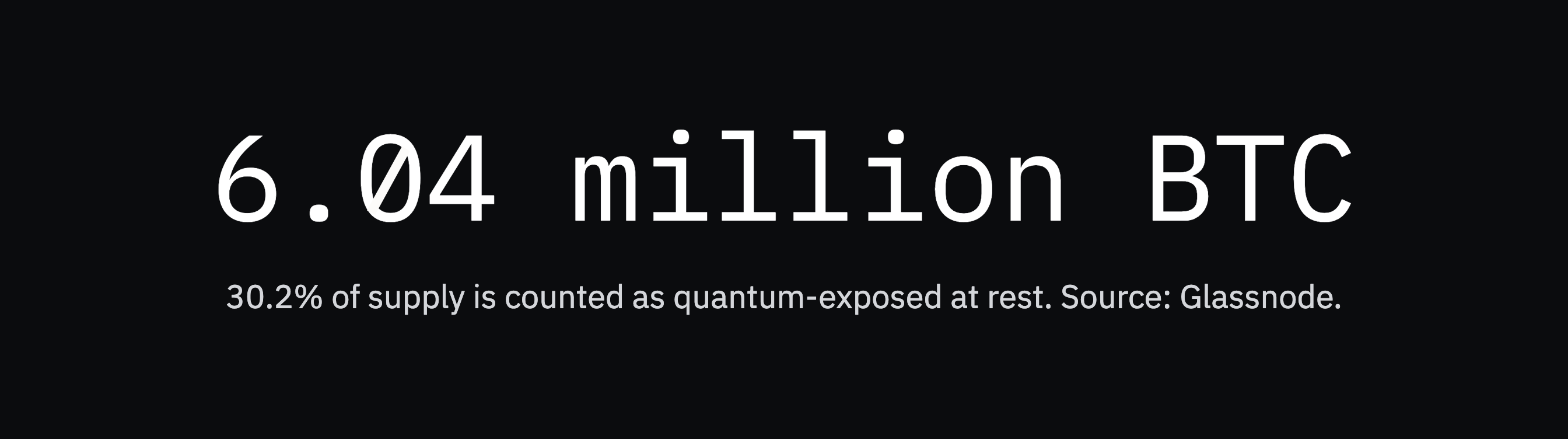
Nobody knows exactly what year quantum computers will break encryption, but the estimates keep moving closer, and fast. Many forecasts now estimate the first practical attack around 2030. Since early 2025, our Quantum Doom Clock has pointed to 2028 as an early window for a cryptographically relevant quantum computer.
In March, Google Quantum AI, working with researchers from the Ethereum Foundation and Stanford, put an ECDSA break at fewer than 500,000 physical qubits, a roughly 20-fold drop from prior estimates. By September, IonQ's end-to-end blueprint had it at roughly 20,000 trapped-ion qubits and 26 days per attempt for Bitcoin.
Setting the bar for "quantum-ready"
NIST finalized its first post-quantum standards in 2024, including hash-based signatures. But coordination is what takes time, and no single party can order a live blockchain to adopt those standards.
The industry has also never agreed on what "quantum-ready" means for a network, or how exactly it should be checked. Today's readiness scorecards don’t give exchanges, custodians, developers, or holders a common reference point. A network can call itself "quantum-resistant" with no common understanding on what that claim covers or what evidence backs it.
The Quantum Alliance was formed to set that bar.
“In the future, ‘post-quantum cryptography’ will just be called ‘cryptography’ and everything else will be in a museum. Our intention with the Quantum Alliance is to front-load a lot of the complex decision-making when making post-quantum blockchain products and create standards that others can simply pull off the shelf as the industry migrates.”
 Christopher SmithFounder and CEO, Quantus
The Alliance is modeled on the Internet Engineering Task Force. It is open to individual contributors, and proposals advance on public evidence, rough consensus, and working implementations. Anyone, from developers to organizations, can join a working group or submit a proposal. Everything the Alliance produces will be published openly, so projects can adopt it directly and anyone can measure a readiness claim against the same yardstick.
Founding contributors include:
- Colton DillionCo-founder and CEO, Postquant Labs
- Dr. Richard T. Carback IIICo-founder and CTO, Postquant Labs
- Richard LeeChief Business Officer, Abelian
- Michal “Mehow” PospieszalskiCEO, AmericanFortress
- Katina MessinisHead of Business Development, Hacken
- Leona HiokiIntmax
- Aaron ChenCTO, Keystone
- Sebastien GuillemotCTO, Midnight Foundation
- Christopher SmithFounder and CEO, Quantus
- Bryn BennettChief Revenue Officer, The Vault
Together, these contributors cover nearly every layer that will require migration: base-layer protocols, privacy networks, rollups, hardware signers, addressing, security auditing, and quantum compute infrastructure.
Four tracks of work
The Alliance’s work will begin in four groups dedicated to blockchain migration, post-quantum zero-knowledge systems, wallet security, and cross-chain compatibility.
- Blockchain migration: how live networks move funds and keys to post-quantum schemes, along with reference designs for migration that address exposed keys, dormant accounts, and the larger transactions post-quantum signatures produce.
- Post-quantum zero-knowledge systems: how to evaluate and benchmark the proof systems that privacy networks, rollups, and cross-chain tools depend on, many of which carry the same elliptic-curve weakness as today's signatures.
- Wallet security: how users and custodians generate, store, and sign with post-quantum keys, from hardware secure elements to recovery flows.
- Cross-chain compatibility: shared specifications so wallets, bridges, and hardware signers handle post-quantum keys the same way on every chain, because a transaction that crosses several networks is only as quantum-resistant as its weakest layer.
Where Postquant Labs fits in
Industry-wide migration has to move wallets, exchanges, custodians, and contracts onto new address types, a process measured in years. Assets in addresses that have already published their public keys stay exposed the whole time.
Ordinary wallet vs post-quantum wallet
| OrdinaryMost wallets today | Post-quantumQuip account | |
|---|---|---|
| What authorizes a spend | Elliptic-curve signature (ECDSA) | Hash-based signature (SHRINCS) |
| Resists Shor's algorithm | No | Yes |
| Long-held balances protected | No | Yes |
| Assets stay on their current chain | Yes | Yes |
| Added cost | None | A small amount of extra gas per transaction |
Quip accounts provide post-quantum wallets now. A Quip account requires a hash-based signature, SHRINCS, to move funds, so the account stays secure even if the chain's own curve breaks. Assets stay on the chains they already live on, including Ethereum and Bitcoin, with no new chain, no soft fork, and no bridge. The same protection covers both legs of a QuipSwap trade.
“We built Quip accounts because asset holders shouldn’t have to wait for every chain to finish migrating to get protection—a quantum computer that can break your account will arrive several years before ones that can break consensus. Right now, there is no common definition of what post-quantum readiness means, and no accepted way to pace your adoption or update your policies and procedures. With the Quantum Alliance, every network and institution will have the standards they need to upgrade for the post-quantum world.”
 Colton DillionCEO and co-founder, Postquant Labs
Postquant Labs’ work maps directly onto the Alliance's agenda. The wallet security track builds on Wallet Security for Post-Quantum Ethereum, an initiative co-authored by our own Richard Carback. We'll bring our deep experience working on post-quantum wallets to the Alliance, while the Quantum Doom Clock will keep tracking the timeline the industry is working against.
FAQ
What is the Quantum Alliance?
An open standards body formed by nine blockchain organizations to define what post-quantum readiness means for blockchain networks, wallets, and infrastructure, and to publish open criteria for testing any claim of quantum resistance.
Is the Quantum Alliance a Quip Network project?
No. The Alliance is independent and open to individual contributors. Postquant Labs is one of nine founding organizations, and no member's size or token holdings give it extra voting weight.
What will the Alliance publish first?
A public definition of quantum readiness covering transaction signatures, key management, consensus, zero-knowledge proof systems, and peer-to-peer connections, along with open test criteria, benchmarks, and reference designs for migration.
Can I protect my assets before the standards are finished?
Yes. Quip accounts protect assets with a hash-based post-quantum signature on the chains they already live on, without waiting for any base chain to migrate. Get started at account.quip.network.
Links
→ Quantum Doom Clock: quantumdoomclock.com
→ Quip accounts: developers.quip.network
→ Explainer: Which blockchains are quantum resistant?
→ Explainer: What is a post-quantum wallet?