
A post-quantum wallet is a wallet whose ownership rests on cryptography no known quantum computer can break. That one sentence does a lot of work, so here is what it means in practice and how to tell a real one from a label.
The problem it solves
Ordinary crypto wallets, MetaMask accounts and hardware wallets alike, prove ownership with elliptic-curve signatures. Shor's algorithm on a large enough quantum computer breaks those, deriving your private key from a public key you have already exposed by transacting. Every serious migration timeline, from NIST's standards to the NSA's CNSA 2.0 deadlines, exists because that break is treated as a when rather than an if.
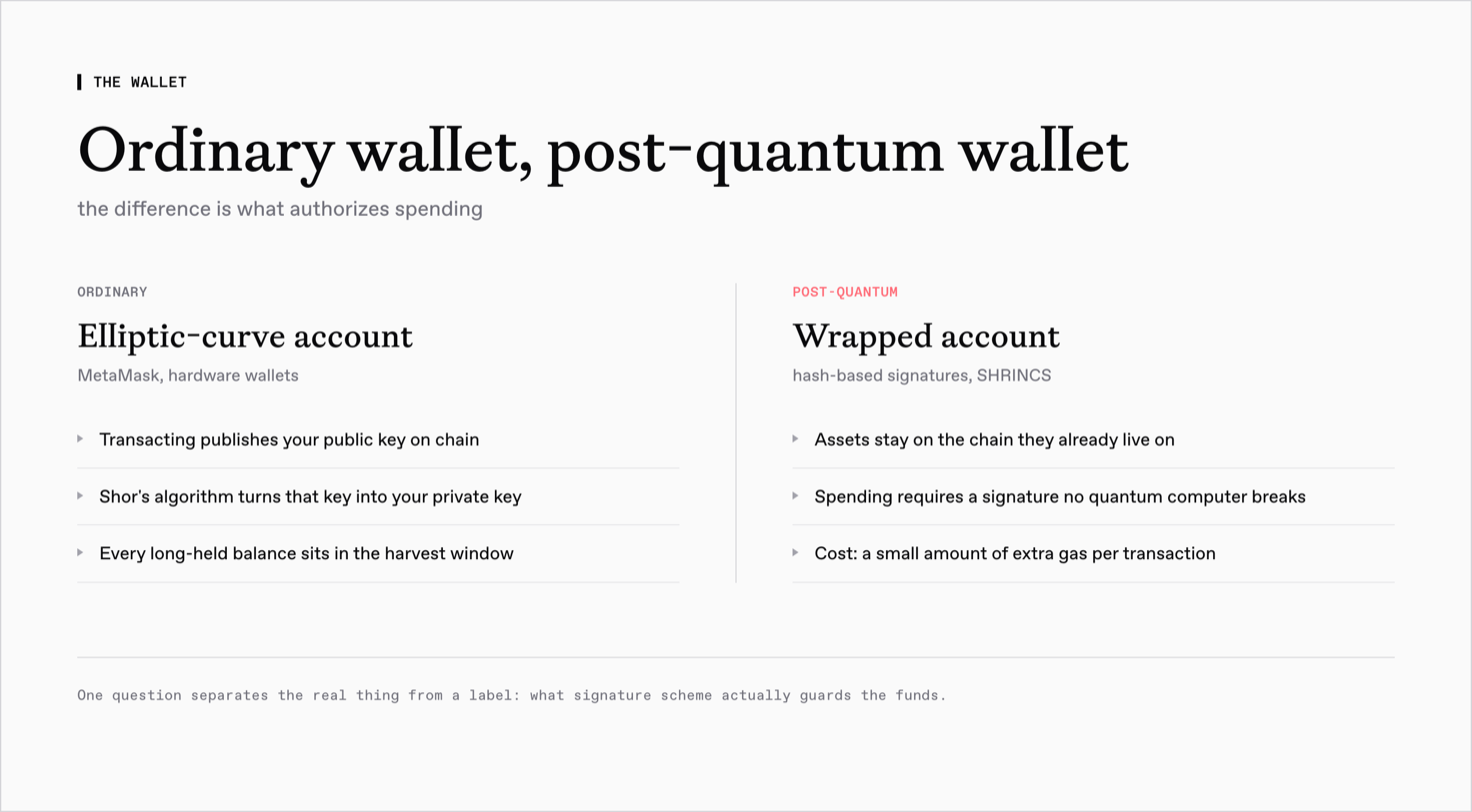
A post-quantum wallet replaces the breakable piece: the signature that authorizes spending. The strongest candidates are hash-based schemes, the family NIST standardized, because they rest only on hash-function security, the same assumption Bitcoin mining already depends on, with no special structure for a quantum algorithm to attack.
Two ways to get one
Native chains. A small set of blockchains launched with quantum-safe signatures built in. QRL is the clearest example: its mainnet has signed every transaction with the hash-based XMSS scheme since June 2018, with no elliptic-curve fallback. The cryptography is sound. The tradeoff is starting over, since your assets and most of the ecosystem do not live there.
Smart accounts on existing chains. This keeps assets where they are. A smart account on Ethereum, an EVM L2, or a Bitcoin L2 requires a post-quantum signature to move funds, so the account stays secure even when the chain's own curve breaks. This is the model Quip Accounts use, with SHRINCS, a hash-based signature scheme, in the ownership path. Assets stay on the chains you already use. The tradeoff is extra gas per transaction, because hash-based signatures are larger than elliptic-curve ones.
How to evaluate any product using the label
Ask one question first: what signature scheme actually guards the funds, and what does its security rest on? If elliptic curves remain anywhere in the ownership path, the label does not apply. Then you can go further: has the implementation been audited with findings published, and does it protect assets you already hold, or does it require moving your assets somewhere new first?
The urgency comes from exposure rather than the date the cryptography breaks. Keys published on chain today are recorded permanently, so protection that starts now covers the store-now decrypt-later window, and protection that starts after the break covers none of it.
We track the time to a cryptographically relevant quantum computer at quantumdoomclock.com.