
No. Ethereum today is not quantum resistant, and the interesting part is what that specifically means, because most of what people fear is wrong and the real exposure is narrower and more actionable.
What breaks and what does not
Ethereum accounts are secured by ECDSA signatures over the secp256k1 curve. A sufficiently large, error-corrected quantum computer running Shor's algorithm derives a private key from an exposed public key, which forges transactions from that account. That machine does not exist today. The Ethereum Foundation estimates that quantum computers could break ECDLP-256 by the early 2030s, with Google planning to internally migrate to post-quantum cryptography by 2029.
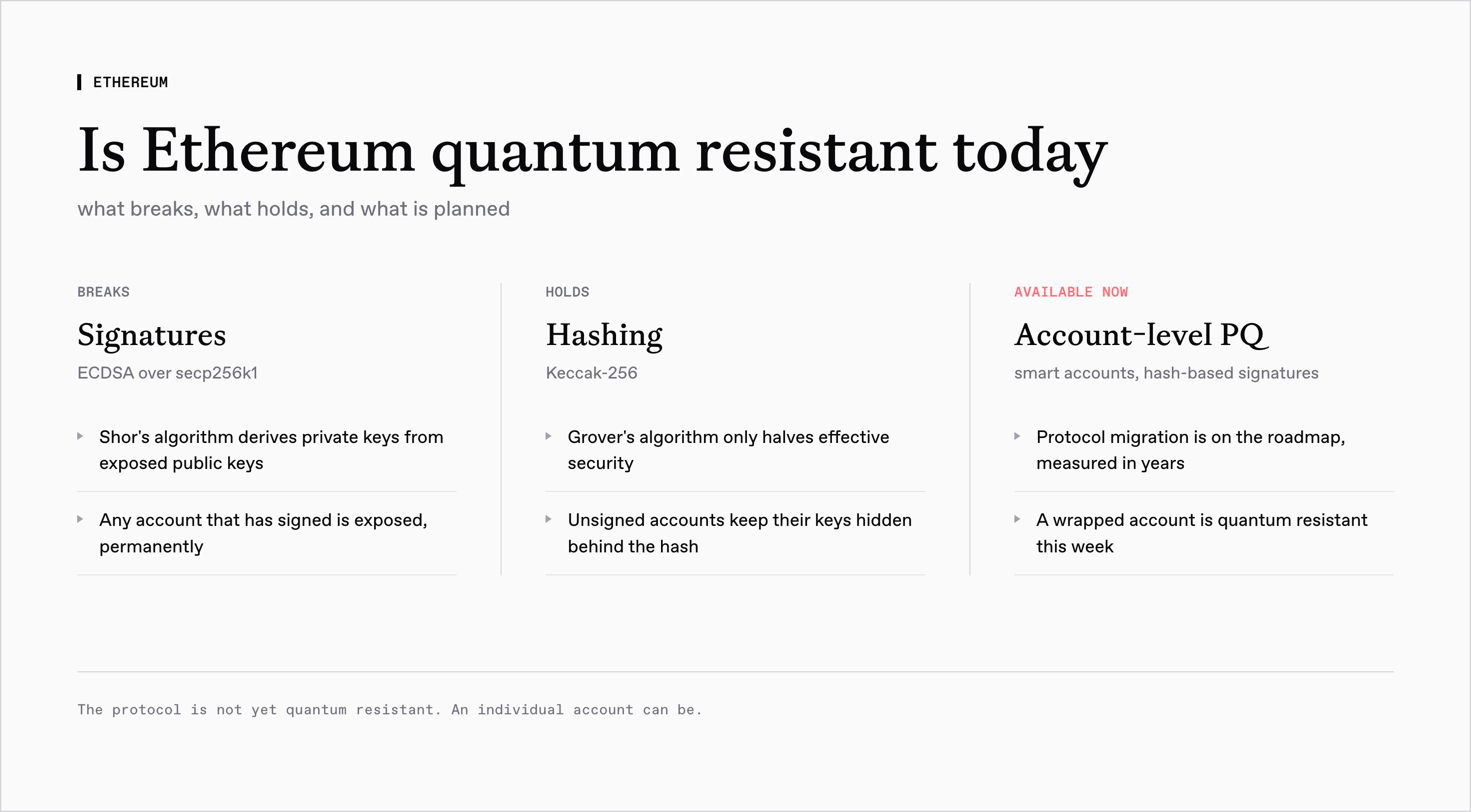
What holds up: Ethereum's hashing (Keccak-256) is only weakened, not broken, by quantum attack. Grover's algorithm halves effective security, which still leaves a margin far beyond attack. The chain does not fall over, but rather it’s specific accounts that are at risk.
One nuance that matters: an Ethereum address is a hash of the public key, so an account that has never sent a transaction has not exposed its key. Signing anything reveals it, permanently. Active accounts are the exposed ones.
What Ethereum is doing about it
More than most chains. The Ethereum Foundation formed a dedicated post-quantum security team in January 2026 and publishes the work at pq.ethereum.org, with the roadmap entry at ethereum.org. The direction is hash-based signatures for validators, and account abstraction that lets individual accounts adopt a quantum-safe scheme before the protocol finishes migrating.
The cryptography is the settled part. NIST standardized quantum-safe schemes in 2024, including hash-based signatures. Coordination is what takes time: wallets, exchanges, contracts and every holder moving to new account types, a process measured in years. Until it is completed, keys exposed on chain stay exposed.
What you can do before the fork
Account-level protection does not need to wait for chain migration. A smart account can require a post-quantum signature to move funds, so even if the underlying curve breaks, the account does not. That is what Quip Accounts do on Ethereum and EVM L2s: assets stay on the chain they live on, held behind SHRINCS, a hash-based signature scheme, at the cost of extra gas per transaction for the larger signature.
So, while Ethereum the protocol is currently not quantum resistant and a full post-quantum migration will take years, an individual Ethereum account can be protected today.