
Ask a vendor what quantum compute costs and the answer is usually a sales call. Some of it genuinely hides behind a "contact us" button, and the rest is published on pages almost nobody reads. A real job today can cost less than lunch.
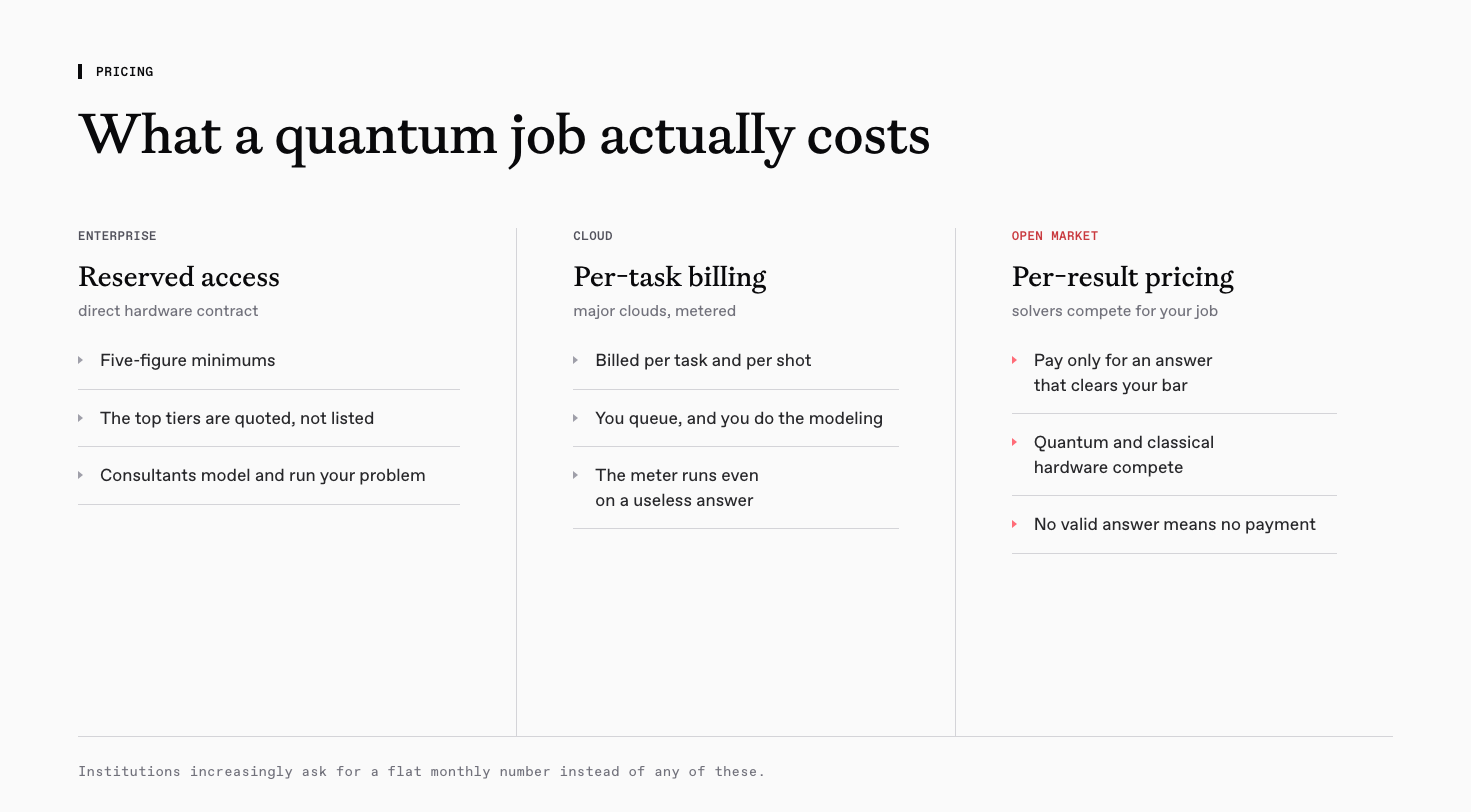
There are three ways to buy quantum compute in 2026: enterprise reserved access (five-figure contracts, negotiated one at a time), cloud per-task billing (accessible but metered and queued), and open-market per-result pricing, where solvers compete for your job and you pay only for an answer that clears the bar you set.
Enterprise reserved access
The traditional route is a direct contract with a hardware provider, which buys reserved machine time, a consulting engagement to model your problem, and a specialist to run it. Minimums typically start in the tens of thousands of dollars, and the top tiers are not published at all, with D-Wave's Leap enterprise plans and IBM Quantum's premium access both quoted rather than listed. Reserving a machine does not always mean a contract that size. The major clouds rent dedicated devices by the hour as well, and tasks run inside a reserved window carry no per-task charge on top, which is the same idea sold in smaller units. For a Fortune 500 running a dedicated research program, this is a reasonable purchase. For a team testing whether quantum helps at all, the entry cost decides the question before the experiment does.
A flat monthly subscription is the other shape this takes. Some vendors already sell one, with an allowance of compute included and metered rates once it runs out. It is also the shape institutions ask for most often. Procurement wants a number that repeats every month rather than a price that moves, and hospitals, banks and logistics operators tend to want a post-quantum readiness assessment alongside the compute.
Cloud per-task billing
The major clouds resell quantum hardware per task or per second of machine time. Running a short annealing or circuit job costs dollars rather than thousands, though the exact figure depends heavily on which device you land on. You still queue behind other users, and the modeling work, translating your business problem into a form the machine accepts, is on you. The meter runs whether the answer is good or useless.
Rates move, so the useful thing is knowing where they live. AWS Braket and Azure Quantum publish per-task and per-shot rates for every device they resell. Braket lists its hourly reservation rates in the same place, and Azure lists its monthly plans alongside the metered ones. The enterprise tiers at D-Wave and IBM are quoted on request rather than published, and those stay quote-only.
Open-market per-result pricing
How it works
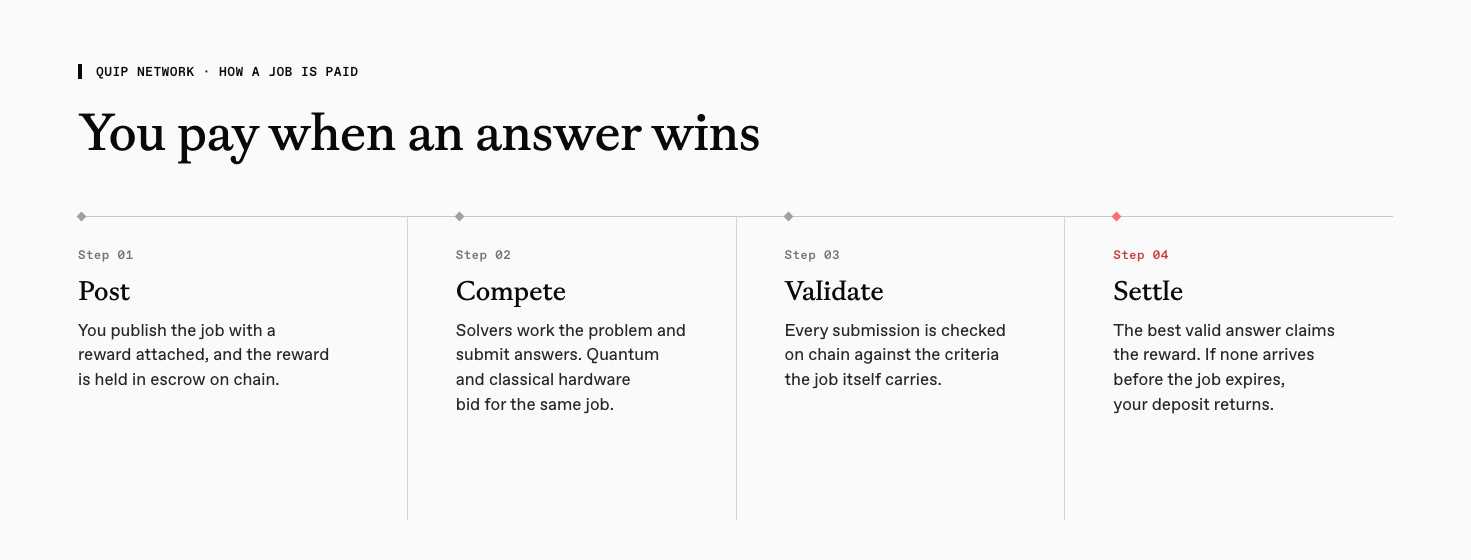
Open-market pricing changes what you pay for, and it is the model we are building at Quip Network. You post an optimization job with a reward attached, and compute providers, quantum and classical, compete to return the best answer. The chain verifies every submission, the best valid answer wins, and you pay only if one clears the bar you set.
Because classical solvers compete on the same jobs, quantum hardware wins only when it genuinely beats the classical alternative on quality or cost. The network runs on idle and excess capacity, so jobs queue here as well, and a posted job carries an expiry rather than a delivery time. The market opens when the network launches, and jobs will be paid in the QUIP token.
Many providers, one endpoint
OpenRouter and Venice do something similar for AI inference. They are not apples to apples with what we are describing, but both do the same basic thing: they gather many compute providers behind one endpoint and send your work to the option that suits it at the price the market is charging. Venice goes a step further and lets you pay in its own token.
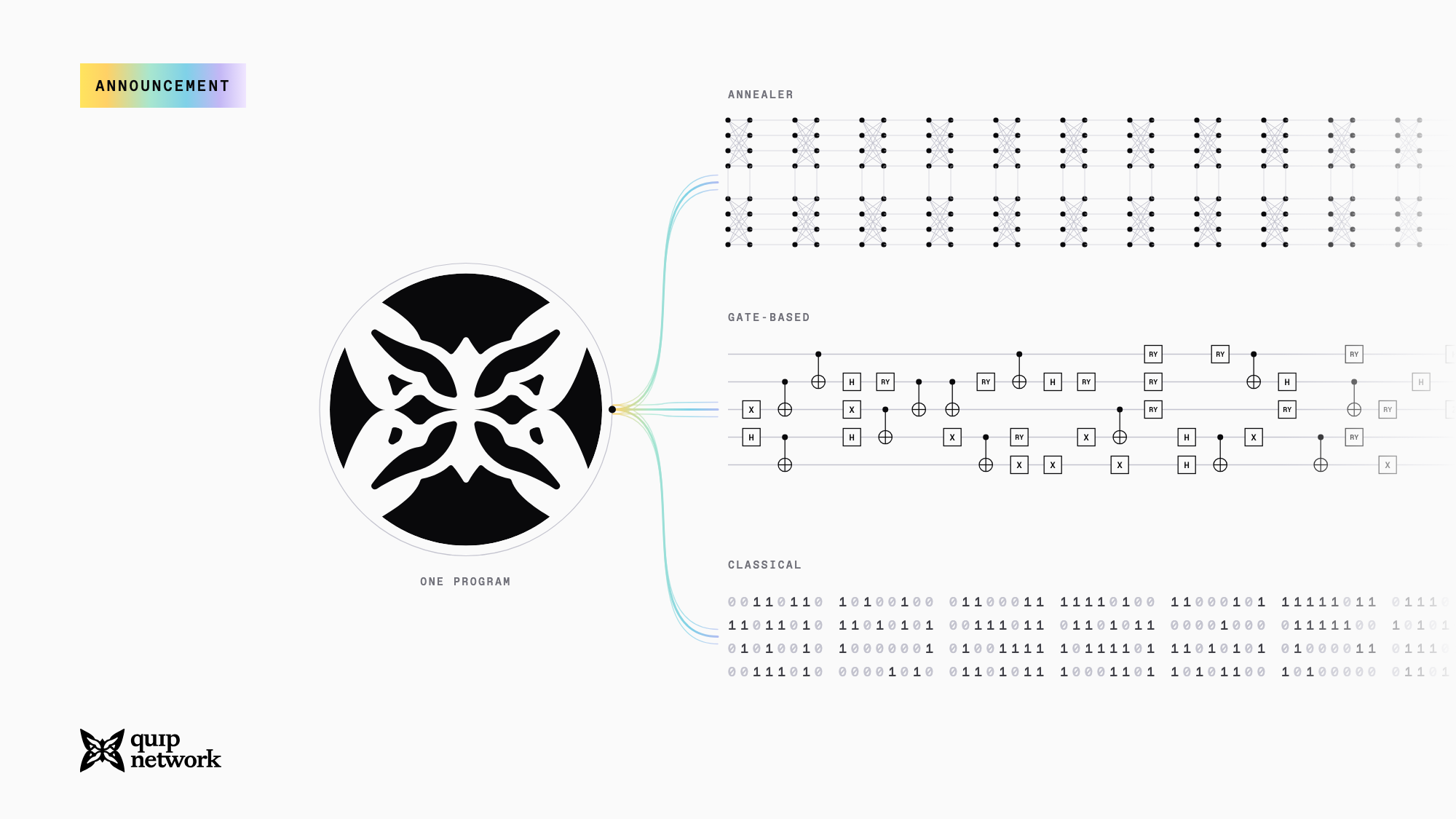
Quantum widens that spread, because the hardware is genuinely not interchangeable. An annealer suits a QUBO, a trapped-ion machine suits circuits that need depth and fidelity, and neutral atoms suit different shapes again. Buy from a single cloud and you get that provider's catalogue, with the job of working out which device fits your problem left to you.
There is no price list to route across, because the answer does not exist yet when you post the job. You name what an answer is worth, and the hardware best suited to the problem is the hardware most likely to win it, so the match happens without you having to know which architecture to ask for.
Buying compute before you need it
Paying in QUIP also means capacity can be bought before it is needed. Prepaying for compute is ordinary practice. Reserved instances and committed use discounts make the same trade of commitment for a better rate, and airlines hedge fuel for the same reason, which is a cost they can put in a budget. The difference is what a cloud commitment actually is, a fixed discount locked to one vendor that expires whether or not you used it. Token-denominated capacity moves with the market instead. Venice shows the same pattern in AI inference, where holding the token entitles you to a recurring allowance rather than a charge on every call. That cuts both ways, and the market can move against you just as easily.
A library of solvers
Buying compute through a cloud pays for the machine and nothing else. On Quip Network the person who wrote the solver is paid as well. An author sets a fee per request, so a good algorithm earns for them every time someone runs it. We expect that to build a library as the network grows. The more people who write solvers and get paid for the ones that work, the better the chance that something already on the network fits the shape of your problem. When one does, you run it and pay the fee instead of modeling the problem from scratch, and the author earns from work they have already done.
Capacity, or an answer
What you pay for is the real difference
Pay for access
- Enterprise minimums start in five figures
- Cloud meters run whether answers are useful
- The top tiers are quoted, not listed
Pay per result
- Post a job, solvers compete to answer it
- Classical solvers compete on the same jobs
- No valid answer means no payment
Where to start
Model your problem first and spend nothing. The major stacks are all Python, and each one ships a classical solver or simulator that runs on your own laptop, so you can get the model right before you pay anyone. That part is the same whether you end up on a cloud, a direct contract or an open market, and the code you write locally is the code you point at whichever one you choose.
After that the question is what a failed attempt should cost you. Metered cloud billing charges for the attempt, so a run that comes back useless costs what a run that works costs. Reserved time is the sound purchase when you already know which hardware suits your problem and need it in a particular window. A flat monthly subscription is the one to ask about when procurement needs a number that repeats, and that shape, with a post-quantum readiness assessment alongside the compute, is one we are working through with institutions now. Paying per result moves the risk onto the solver instead. They spend their own compute, and a submission that misses the bar you set earns nothing, so the only thing you are ever billed for is an answer you can use.
That is what Quip Network is built for. The docs walk through modeling a problem and posting your first job. Start at docs.quip.network, or talk to us if the monthly shape is the one you need.