

Quantum hardware exists and it works. And it is no longer sitting only in university labs: quantum computers from companies like IBM and D-Wave are being accessed by researchers and businesses today, with applications ranging from optimization and logistics to chemistry and materials science. The bottleneck is not whether the technology is here, but who can work with it.
Getting time on a quantum computer has usually meant a consulting engagement, a reserved-time contract, and a specialist on your payroll who knows which knobs to turn. The access model is what keeps almost everyone away from it.
The short version
Only a small group of people can program these machines directly. Everyone else has been standing in a line that barely moves. Quip Network turns that line into an open market: post a job, hardware competes to answer it, pay per result at the going rate.
Users don’t have to worry about the quirks of specific quantum architectures or their pricing models, nor do they have to understand cryptocurrency tokens and liquidity management. They write programs in Python to solve hard optimization problems and pay by the request, putting idle processors to work.
What quantum computers are actually good at right now
Set aside code-breaking. That is a different machine and a different decade. The quantum computers that are commercially useful today, annealers like D-Wave's most of all, are optimization machines. They search enormous solution spaces for the lowest-energy answer to a question: the shortest route for fifty trucks across eight hundred stops, the best portfolio allocation under a hundred constraints, or the most efficient way to organize and schedule a factory floor.
These are called Ising model problems, and they are the standard form that more than a hundred known industrial applications take, from packing and vehicle routing, to job scheduling and portfolio design. If your question sounds like "what is the best, fastest, or cheapest way to do this," it can probably be written as one.
The access model, inverted
Quip Network turns quantum computing into an open market. Rather than reserving a machine, you post a job with a reward attached, and compute providers compete to return the best answer. Quantum and classical hardware bid on the same job. You pay for the result, per request, at the market rate.
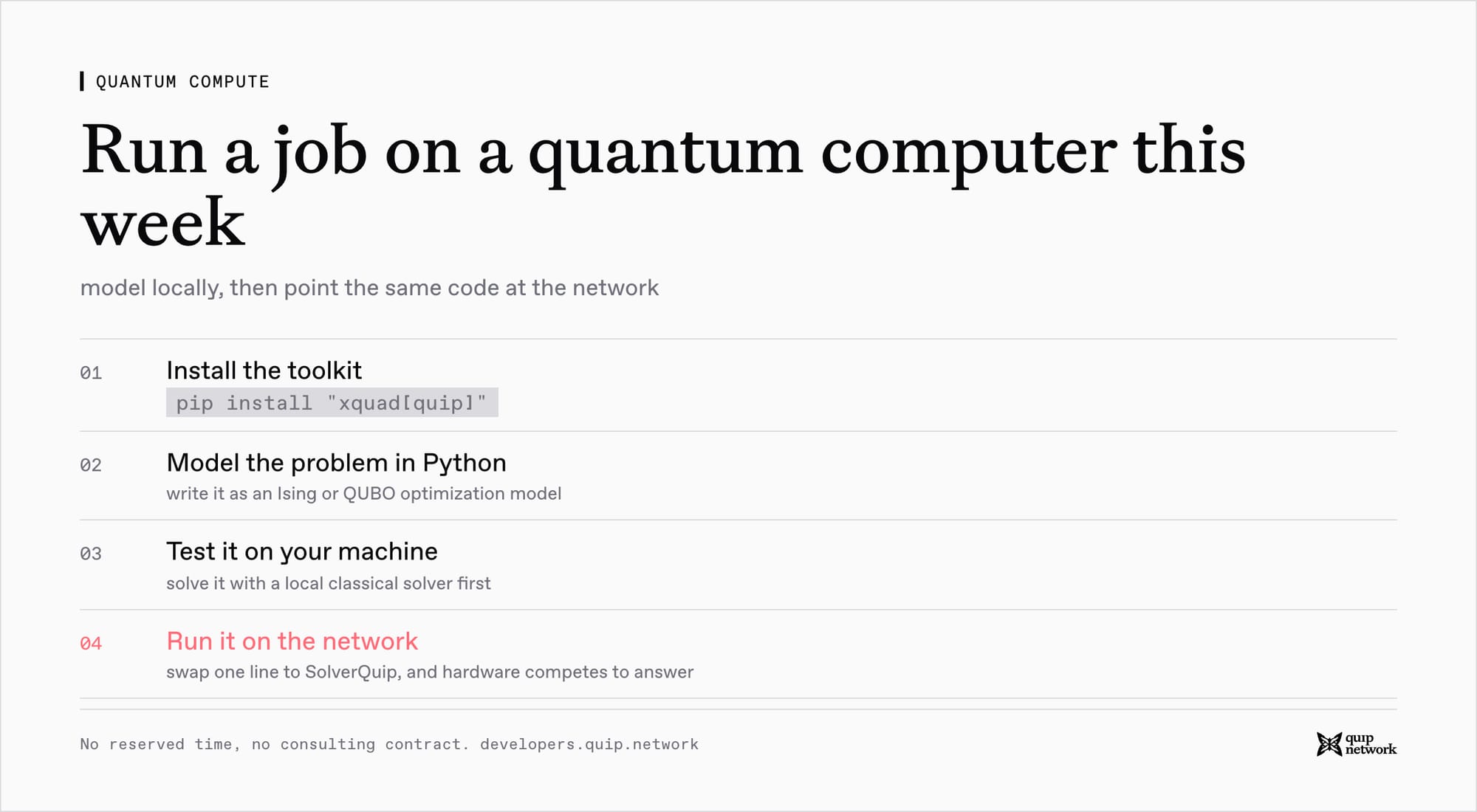
The workflow is Python, and the network step is a few lines (XQuad 0.4.3):
pip install "xquad[quip]"

from xquad.sa import SolverDWaveCPU
from xquad.sa.quip import SolverQuip

# Solve locally
result = SolverDWaveCPU().solve(model)

# Connect to the aglais test network
solver = SolverQuip.for_network("aglais")

# Draft an order: every option is checked before anything is spent
order = solver.create_order(model)

# Price it: reward plus fee, nothing is sent
print(order.quote())

# Submit it and wait for the answer of the solver the chain pays
order.submit()
best = order.wait().best()
print(best.sample, best.energy)

# The chain's record: fee, winner, payout
print(order.receipt())
You model the problem locally and test it against a classical solver on your own machine. When it works, the network solver is built from a preset that already knows the RPC endpoint and faucet, and uses a local keystore as the account, created and funded on first use. You draft an order, see its price before anything is spent, submit it, wait for the answer from the solver the chain pays, and read the chain's receipt: fee, winner, payout. If the model doesn't fit the network's topology, the order raises an error before anything is spent.
No consultation calls. No reserved time. You don't need a quantum background to run a job.
One detail worth knowing: classical and quantum hardware solve the same problems on the same network, which produces a public record of which platform actually wins on which class of problem. Quantum advantage stops being a claim in a pitch deck and becomes a number you can check.
Who this is for
Researchers who published an optimization algorithm and never had hardware to run it against. Operations teams already living in Gurobi or CPLEX who want to benchmark a different machine on their real problem. Developers who want to publish a solver once and get paid every time someone runs it.
Model a problem, run it locally, then run it on the network.
Get started at developers.quip.network.