
Quip Network is a decentralized marketplace for quantum computing. It connects the people who need quantum compute with the operators who have it, routes each job to the hardware best suited to solve it, and verifies the result. You pay only for the compute you use, and you don't need to own hardware, sign a long-term contract, or have a PhD in quantum physics.
The problem it solves
Quantum computers have started to outperform classical hardware on specific kinds of problems, particularly optimization in finance, logistics, manufacturing, and science. Very few organizations can actually use that capability. The machines cost tens of millions of dollars, are difficult to operate, and are usually locked behind reservation contracts that start around $50,000. There's no way to spin up quantum compute on demand the way you can rent a cloud CPU/GPU.D-Wave, a leader in quantum computing, surveyed business leaders and found that more than half plan to build it into their workflows, but most have no practical way to start. Quip Network was built to remove that barrier.
How it works
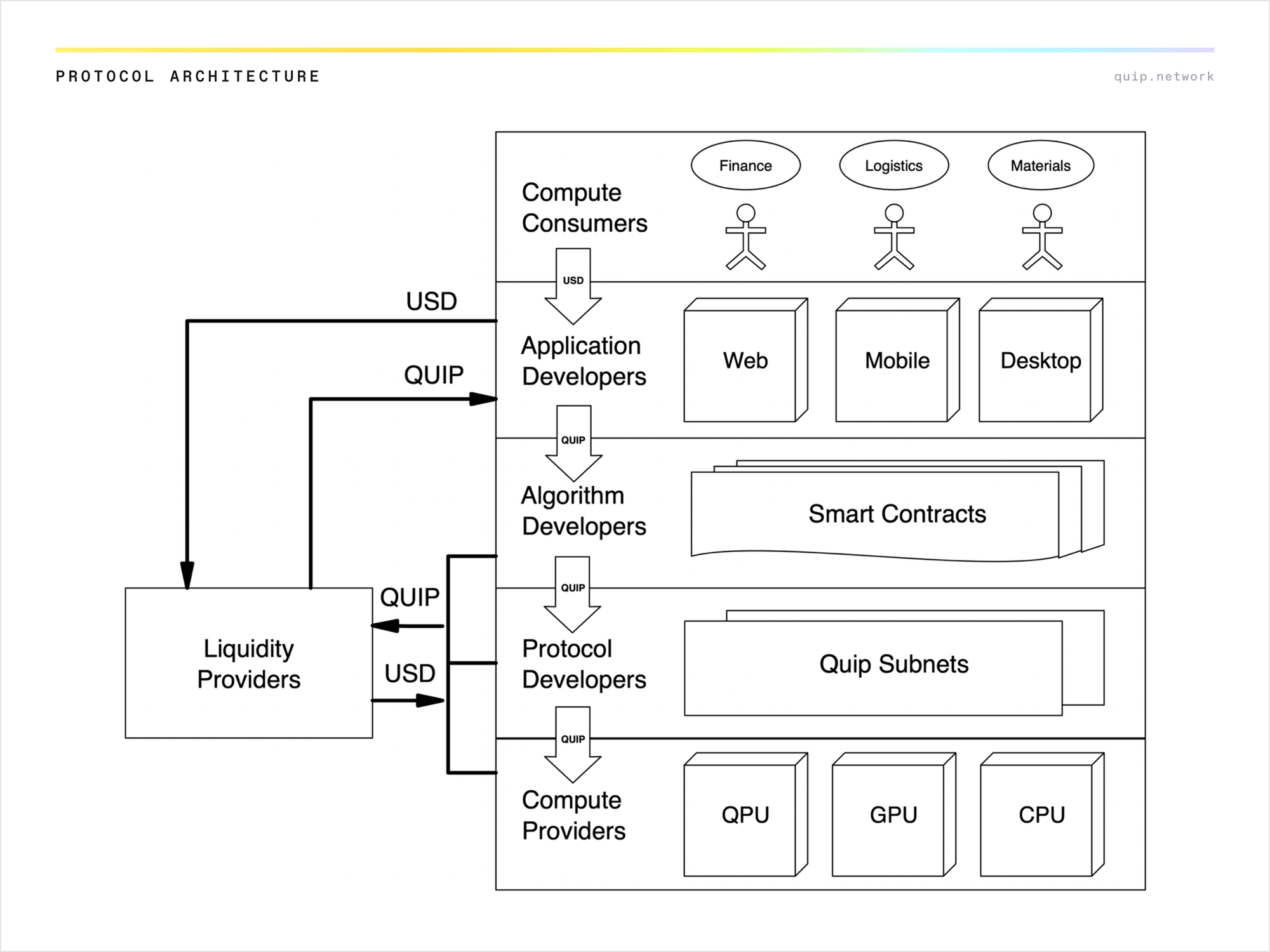
Quip Network runs as an open marketplace. Hardware providers list their spare capacity, and consumers submit a workload and bid for compute. The network routes each job to the architecture best suited to solve it, drawing on real quantum hardware providers, alongside classical GPUs and CPUs. When the job is finished, the network verifies the result before the consumer pays. Operators earn QUIP for solving and verifying work.
The first quantum subnet was built in close collaboration with D-Wave and focuses on optimization problems.
Who it's for
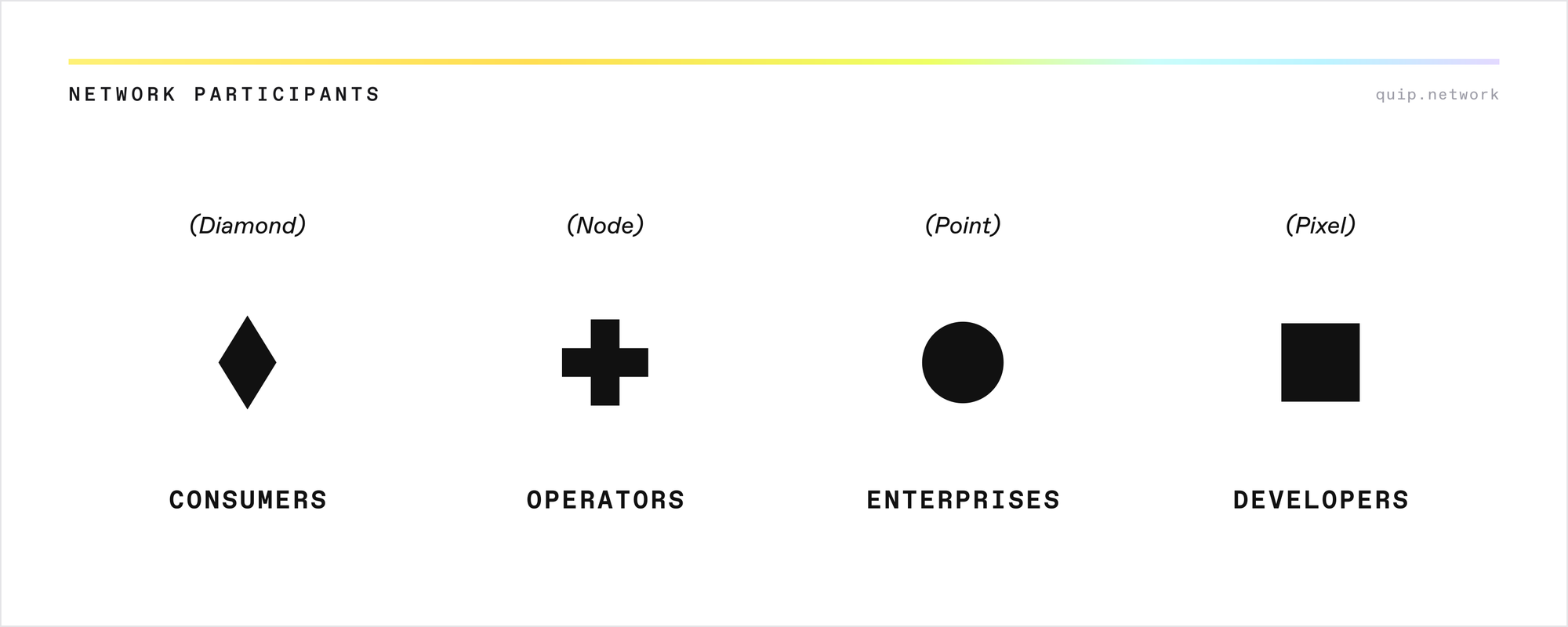
Four groups meet in the marketplace, and each plays a different role.
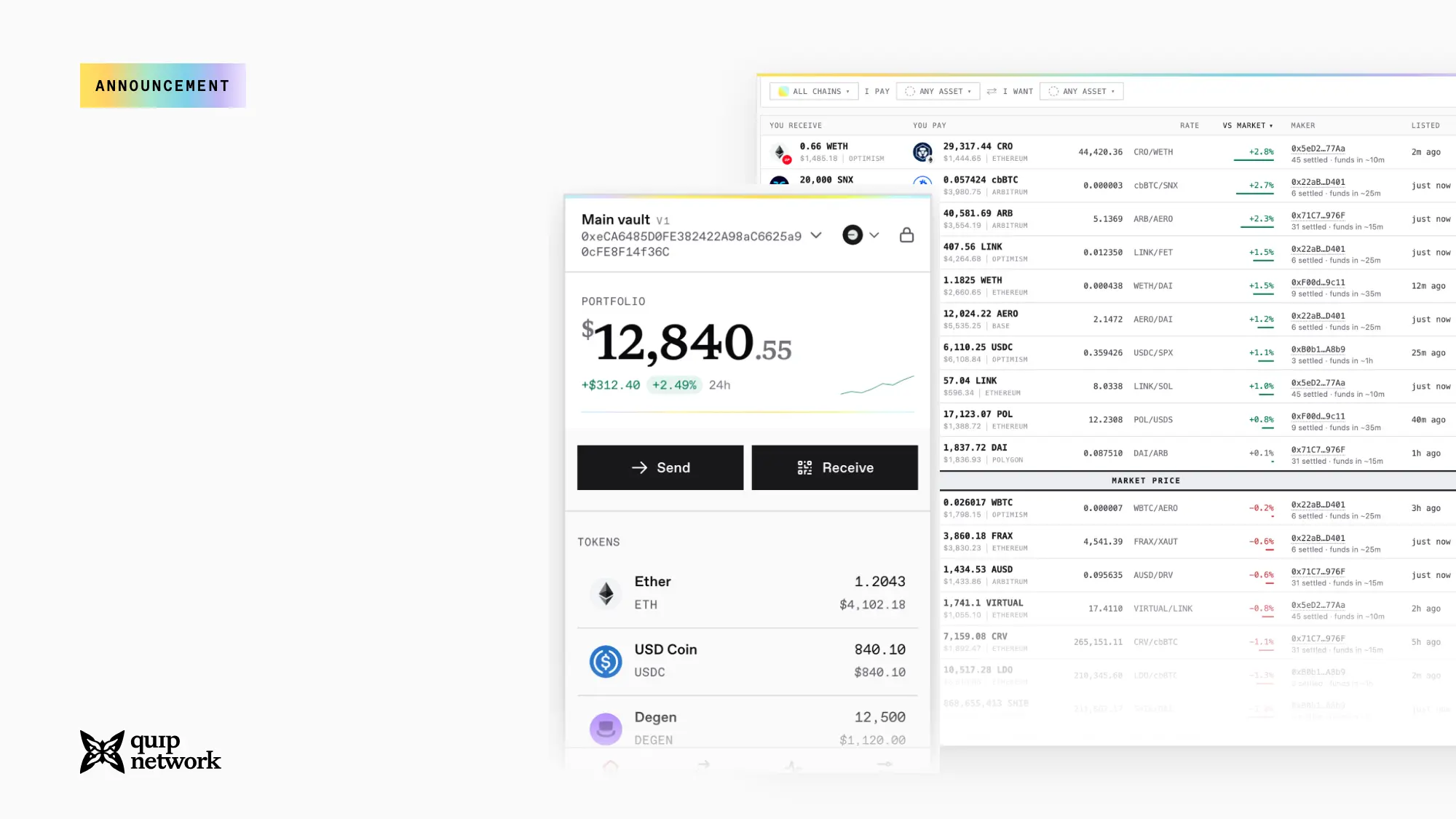
Consumers submit optimization problems, or run a prebuilt solver from the open marketplace, and pay spot rates for only the compute they use. The network's clearinghouse matches buyers and sellers in real time, so compute is priced like a commodity: no reservations, no five-figure minimums.
Operators run a node on hardware they already own. Quantum processors, GPUs, CPUs, ASICs, and even exotic platforms like neuromorphic and thermodynamic computers all earn QUIP for solving and verifying paid work.
Enterprises bring the workloads where quantum compute matters most: portfolio allocation, risk and fraud modeling, fleet routing, manufacturing scheduling. A dedicated enterprise layer keeps their data, their algorithms, and the fact that they're running quantum at all off the open network.
Developers get paid every time their solver runs. The protocol is open source, and it needs classical developers for data pipelines, node tuning, and front-ends as much as it needs quantum algorithm designers.
Proof of Useful Work
A blockchain needs a way to decide who produces the next block. Bitcoin does this with Proof of Work (PoW): miners burn energy solving puzzles that are deliberately useless, and the effort itself is what secures the chain. Quip Network uses Proof of Useful Work (PoUW) instead. The optimization problems that consumers submit are the same problems miners solve to earn the right to produce a block, so the work that secures the network is work someone actually wanted done.
What makes this practical is verification. For most useful work, like running an AI model, the rest of the network can't confirm a result without redoing the whole job, which defeats the purpose. Optimization is different. A proposed solution is cheap to check even when it was expensive to find, so the network can confirm answers quickly without re-spending the compute it was trying to save.
What it's used for
Most early demand is optimization: routing, scheduling, portfolio allocation, and similar problems where a small improvement translates into real money. A 0.5% better answer on an $800M manufacturing operation or a $10B portfolio is meaningful. Beyond optimization, the network can serve verifiable randomness for applications that depend on provably fair outputs, and it benchmarks hardware performance across architectures using real workload data.
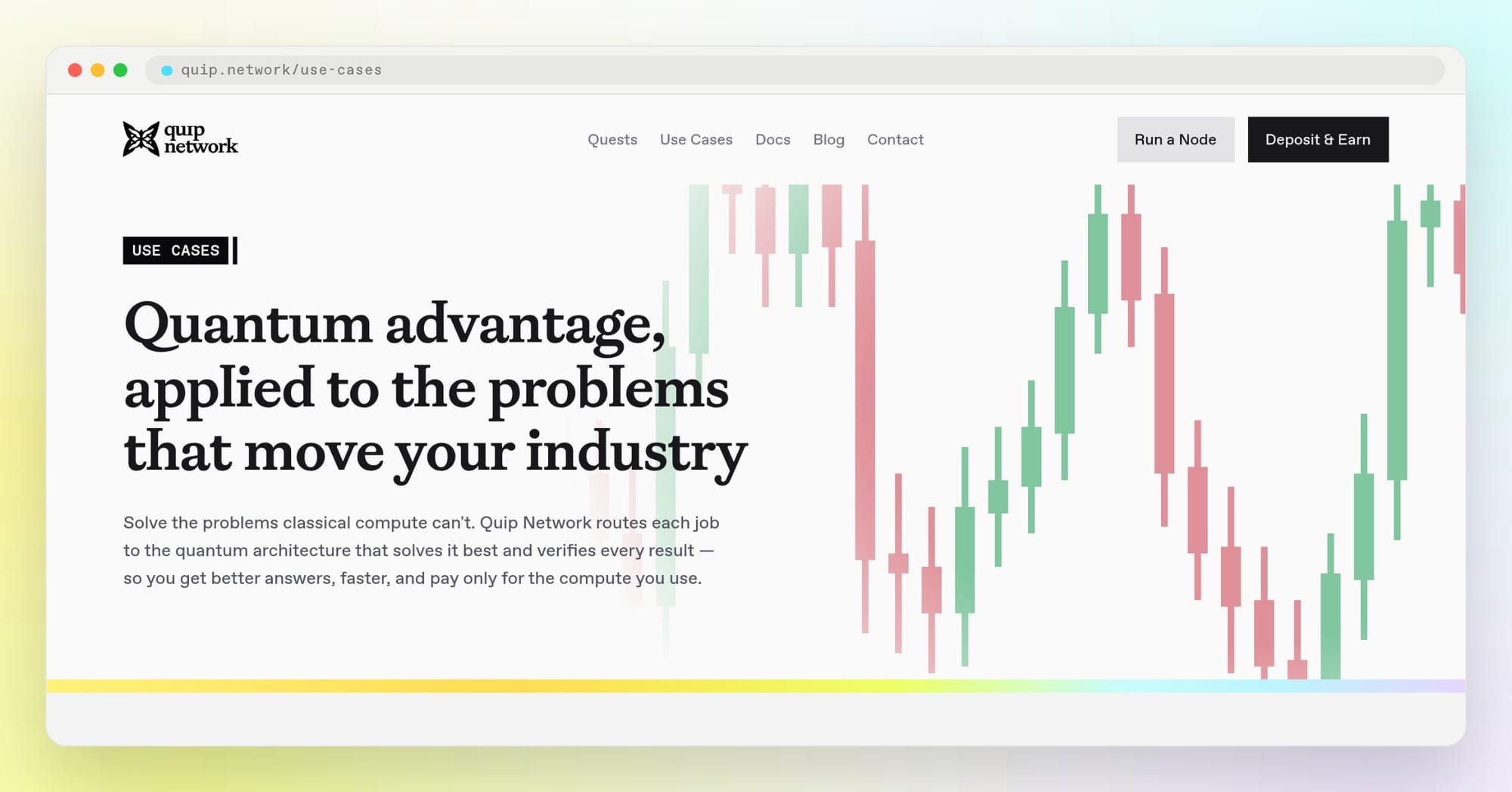
A use case breakdown by industry, including finance, logistics, manufacturing, and science, is at quip.network/use-cases.
Post-quantum security
Alongside compute, Quip Network provides a quantum-resistant security layer for assets on existing blockchains. The same cryptography that secures the network protects user funds, wrapping them in post-quantum protection with no migration and no new wallet to set up. The layer also enables bridgeless cross-chain swaps, moving assets between chains without a bridge or an oracle. Quantum-resistant wallets are live on Ethereum, Solana, and Bitcoin today. More than 20,000 have been deployed, protecting over $1 million on chain.
Protect your wallets from quantum attackers today at account.quip.network.
The QUIP token
QUIP is the network's native token, designed as the unit that keeps the marketplace running once it goes live. Consumers will pay QUIP to submit jobs and move assets, miners will earn it for contributing compute, and validators will stake it to finalize blocks.
Colton Dillion (co-founder and CEO) explains Quip Network at ETH Denver.
What's live today
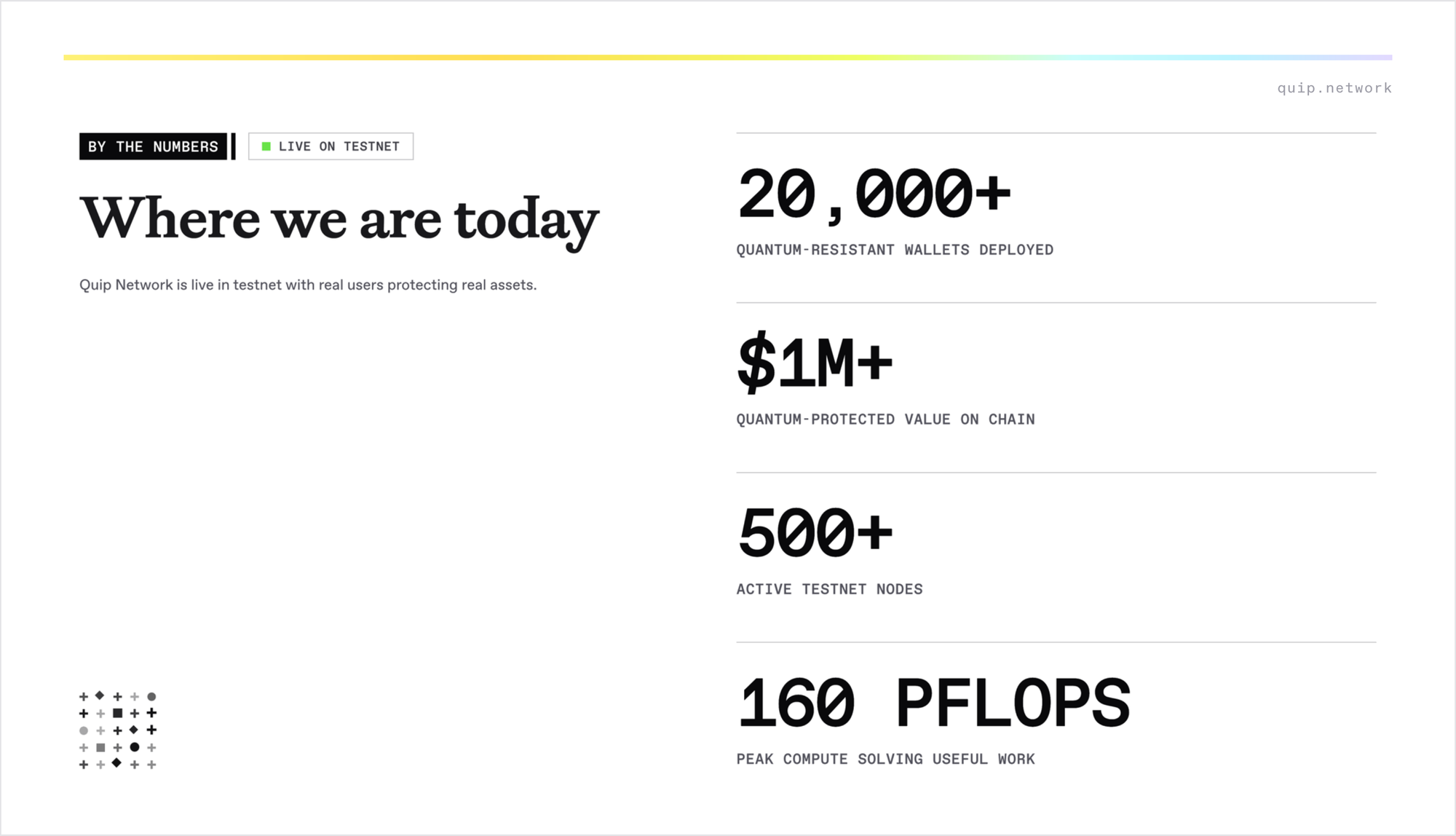
The testnet is public, with users already testing the network and creating quantum-resistant wallets. At peak it has run more than 500 nodes at once, reaching 160 PFLOPS of useful compute. The codebase is fully open source.
You can run a node on hardware you already own to help stress-test the network ahead of a broader launch and earn rewards for it. The setup guide is at quip.gitbook.io/docs/nodes/run-a-node-testnet.
About
Quip Network is built by Postquant Labs, a research lab for the post-quantum era that also maintains the Quantum Doomsday Clock, a running estimate of when quantum computers will be able to break today's cryptography. It was co-founded by Colton Dillion (@cadillion, CEO) and Dr. Richard Carback (@rcarback, CTO), and you can meet the rest of the team at quip.network/team.
Links
→ Website: quip.network
→ Docs: quip.gitbook.io/docs
→ GitHub: github.com/quipnetwork
→ Whitepaper: quip.network/documents/Quip-Whitepaper.pdf