Yes, and here is how to check rather than take our word for it. Quip Network is built by Postquant Labs, the code is public, the contracts have been reviewed by an independent auditor, and the testnet has been live since April 2026.
It’s worth saying first: if you searched for Quip and landed on reviews of a toothbrush or a Salesforce document tool, those are different companies that share the name. This is quip.network, and we work on post-quantum security and distributed quantum compute.
What Quip Network actually is
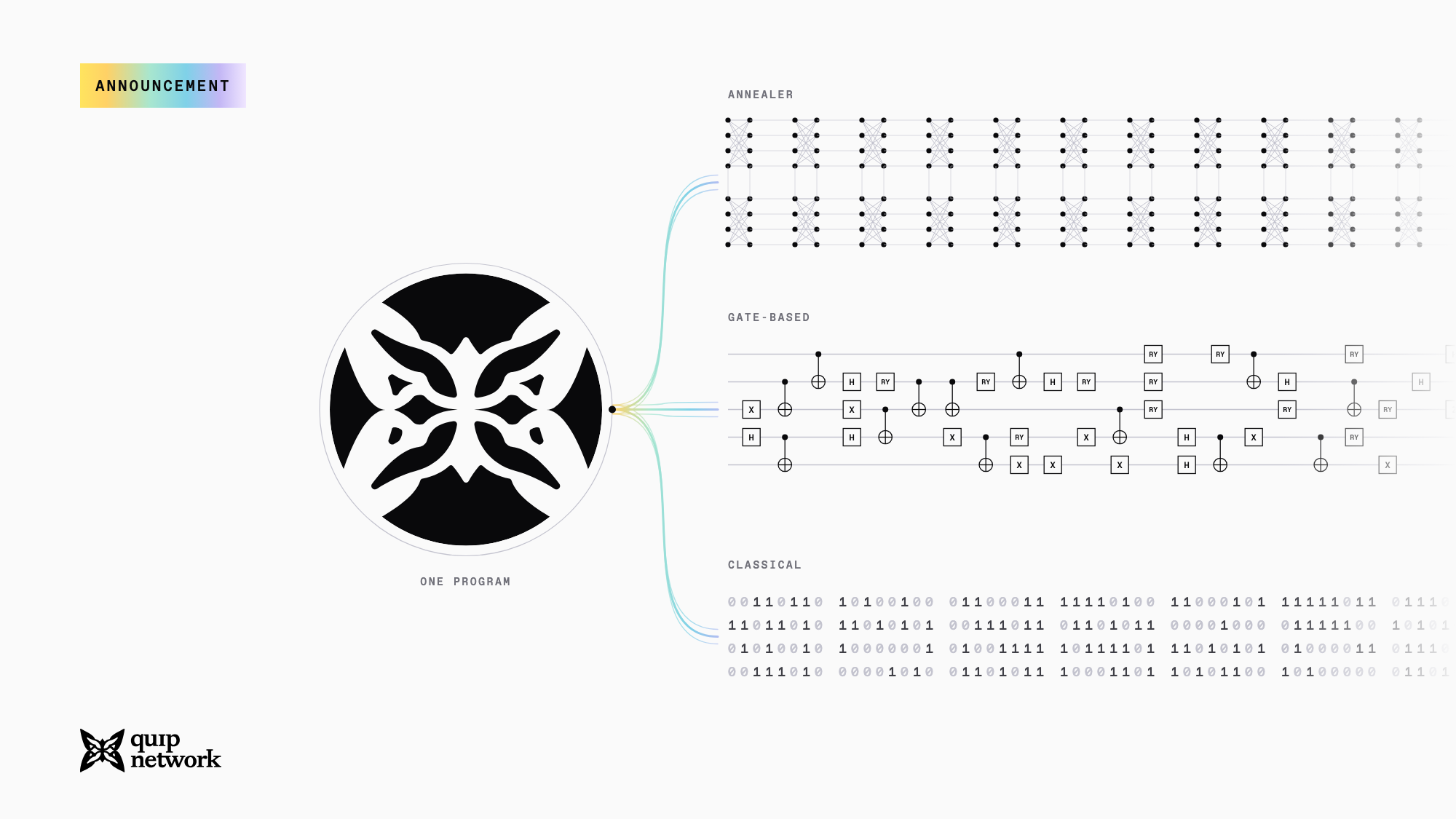
Quip Network is a distributed quantum computing cloud: an open marketplace where consumers submit workloads and operators running QPUs, GPUs and CPUs compete to solve them. Optimization problems get routed to nodes through a consensus mechanism that pays for useful work instead of hashing. The quantum randomness service, QVRF, is the first product built on it.
Running a cloud with quantum computers on it has a direct consequence: the network can’t be vulnerable to its own participants. The network can’t rely on cryptography those machines could break. So Quip also deploys quantum-resistant infrastructure.
Wallets show why this matters. They are guarded today by elliptic-curve signatures, and a large enough quantum computer breaks those. Quip Accounts add a post-quantum signature on top of the signature the chain already uses, so assets stay on Ethereum, EVM L2s and Bitcoin L2s rather than migrating anywhere. Quip uses post-quantum signatures (SHRINCS, a hash-based scheme) through its open-source pqhybridsign library, always paired with the chain’s existing ECDSA or secp256k1 signature. QuipSwap, which lets two parties swap assets on one chain or across chains without bridges, oracles, or keys for a quantum computer to break, is built on the same network.
Who is behind it
Colton Dillion is the co-founder and CEO, previously CMO at Acorns, CEO/CTO at Hedgehog, and co-founder of Gentlemen Labs (DEGEN).
Dr. Richard Carback is the co-founder and CTO, a cryptographer with published research on elections and privacy tech and a co-founder of the xx network.
The company building Quip Network is Postquant Labs. Neither founder is anonymous, and both have public track records you can look up independently, which is the first thing worth checking about any blockchain project.
What you can verify yourself
This is the part that matters more than anything we say about ourselves.
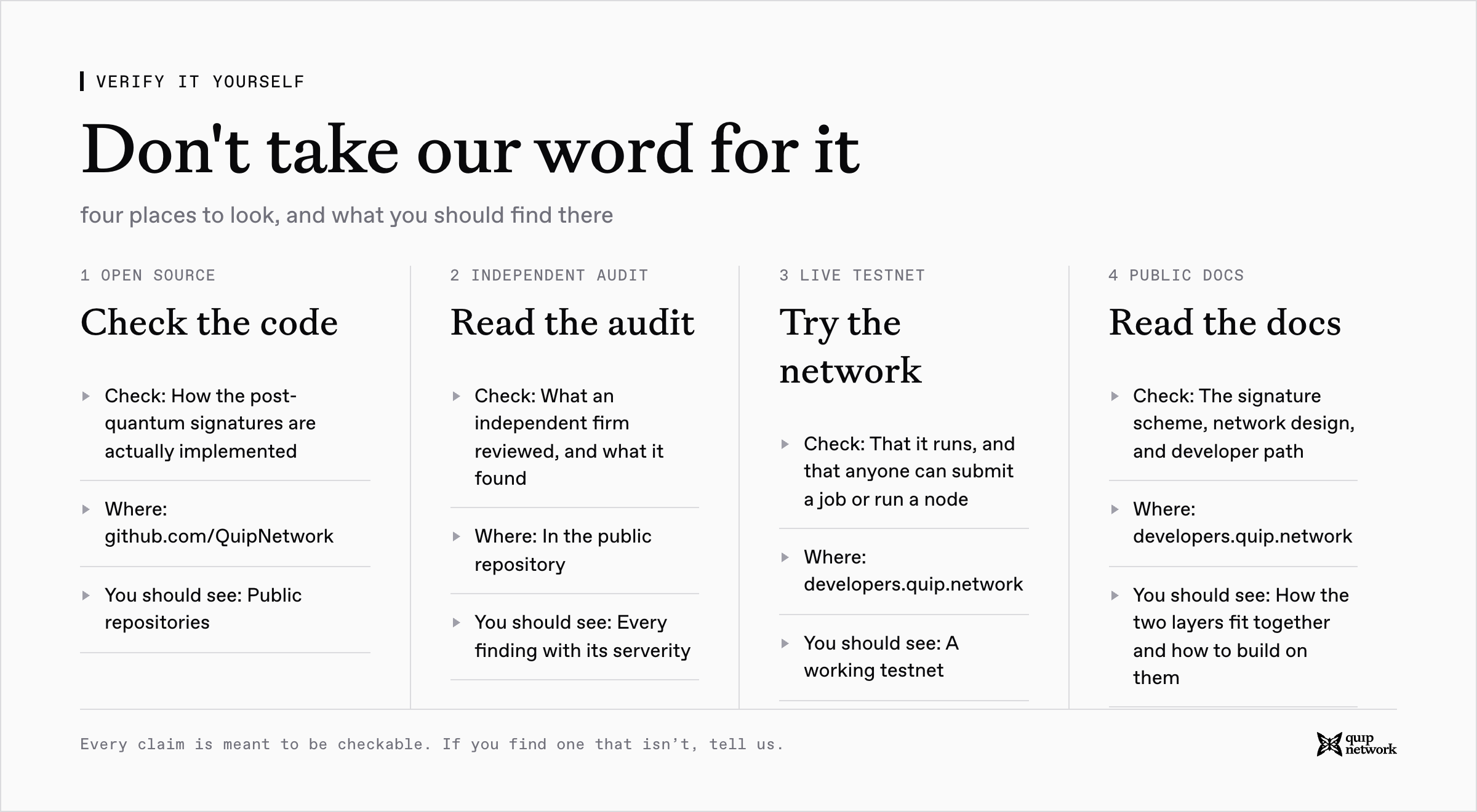
The code is open. The repositories are public, including the signature implementations. You can read how the cryptography works rather than trusting what we say about it.
The contracts were audited externally. Oak Security reviewed the swap contracts, the hash-based signature verifier stack and the smart-account suite, and published the full report with every finding on September 24, 2026.
The testnet is live and open. It launched in April 2026 and anyone can use it. You do not need permission, an allowlist, or a call with a sales team.
The documentation is public. developers.quip.network describes the signature scheme, the network design and the developer path. Projects that do not want scrutiny do not usually publish that.
What we do not claim
A trust page that only lists strengths is not a trust page.
We do not claim quantum computers can break Bitcoin today. No known quantum computer can. The reason to act now is the store-now-decrypt-later problem: an exposed public key can be recorded today and attacked whenever hardware catches up, so anything you intend to hold for years needs to be protected now.
We do not claim to have built quantum hardware. We route work to machines other people built, and we say which ones. Today that includes D-Wave’s Advantage2 quantum annealers.
We do not claim the network is finished. Some steps are deliberately manual in this version and are documented as such.
The honest risks
Post-quantum signatures cost more gas than elliptic-curve ones. That is a real trade-off and we have not hidden it.
Quantum timelines are uncertain. Experts surveyed each year for the Global Risk Institute put meaningful probability on the early 2030s, which is neither next year nor never. Anyone giving you a precise date is guessing.
And a testnet is a testnet. Treat it as one.
Still checking?
Read the documentation at developers.quip.network, read the code, or try out the testnet Every claim on this page is meant to be checkable, and if you find one that is not, tell us.