A blockchain is deterministic by design. Every node has to reach the same result from the same inputs, so a contract has no private source of chance and has to borrow one. Each common option asks you to trust someone.
QVRF gives a smart contract random numbers that come from measurements on real quantum hardware, delivered through the same request-and-callback pattern that existing randomness oracles use. Each number ships with a transcript you can re-run to check how it was measured, committed and audited.
Why smart contracts struggle with randomness
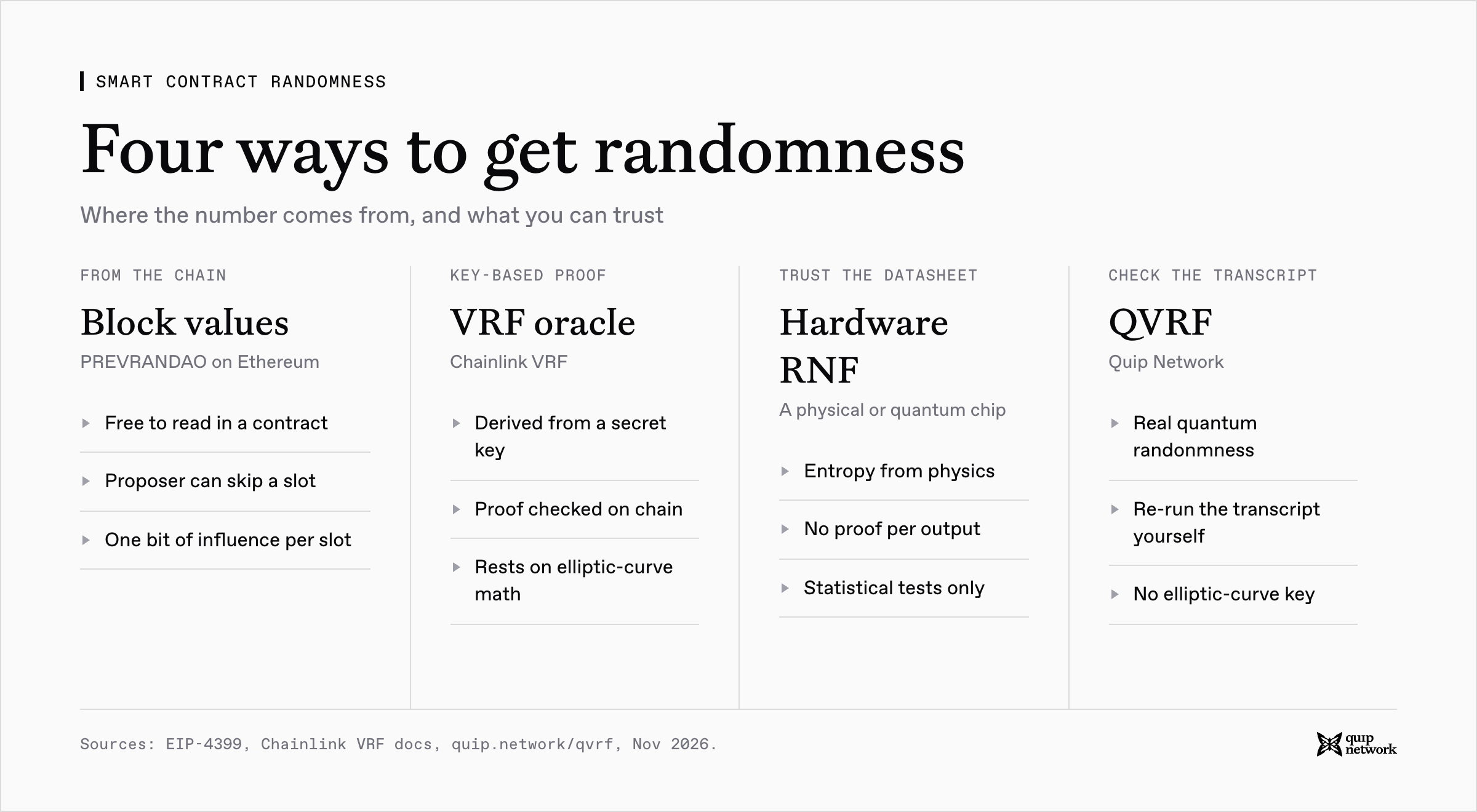
Contracts have three common places to borrow randomness from. Each one puts the trust somewhere different.
Block values. Ethereum exposes beacon-chain randomness to contracts through the PREVRANDAO opcode. It costs nothing to read, but EIP-4399 warns that a proposer can skip a block to stop the value updating, which gives every proposer one bit of influence per slot. That is fine for low stakes and risky when a draw pays out.
VRF oracles. Services such as Chainlink VRF compute the number off chain from a secret key and return it with a proof, which a coordinator contract checks on chain before calling your contract back. Checking the proof where the money sits is a real strength. The tradeoff is underneath: unpredictability rests on the key staying secret, and the proof rests on elliptic-curve math that a sufficiently large, error-corrected quantum computer could break, the same weakness behind exposed wallet keys.
Hardware random number generators. A quantum RNG chip draws on physics, but the buyer gets a number and a data sheet. Statistical tests can show output looks uniform. They cannot show it came from a quantum source, or that nobody picked which outputs to hand over.
How a QVRF number gets made
A Quantum Verifiable Random Function is a random number that comes with proof of where it came from. QVRF runs on Quip Network's second subnet, where gate-based quantum computers are paid to run random circuit sampling. Every number passes through four steps.
- Measure. Quantum hardware runs circuits generated from a seed and returns raw samples. The challenge that picks the circuits comes from a public randomness source, and the answer has to come back within a deadline too short for a classical simulation to meet.
- Commit. Every sample is hashed into a Merkle tree, and a commitment to the set is published on chain. From then on, nothing in the set can be swapped.
- Audit. Only now is a subset chosen, re-simulated on classical hardware and scored with cross-entropy benchmarking, which measures how closely the samples match what the circuit should produce.
- Extract. A Toeplitz extractor condenses the audited samples into near-uniform bits.
The order carries the security. Because the commitment lands before the audit set is picked, nobody can choose which results get checked.
The method follows the certified-randomness protocol a JPMorganChase-led team and Quantinuum demonstrated in Nature in 2025 on a 56-qubit trapped-ion processor. Certification is the heavy part: that experiment's 71,313 bits took supercomputers sustaining 1.1 exaFLOPS to check.
The difference from a standard VRF is where the number comes from. A standard VRF derives its output from a private key, so its unpredictability rests on that key staying secret and on elliptic curves staying hard. QVRF derives its output from a physical measurement and hands you the transcript to check it against, so you can verify a number after delivery without trusting us.
What your contract sees
From the contract's side, QVRF looks like an oracle you already know. The contract asks for random values and receives them later through a callback. Quantum Echoes is the first live use: each mint on Ethereum requests a seed from the QVRF coordinator, and the token's traits come from the quantum randomness that returns.
QVRF is also designed to take payment over the same mechanism QuipSwap uses to settle trades across chains, so buying randomness won't tie you to one network.
When QVRF fits
For a low-stakes game, PREVRANDAO read at least four epochs ahead may be enough. If you need a proof your contract checks on chain today, a VRF oracle gives you that, with an elliptic-curve key underneath.
QVRF fits the draws someone will question later: mints, lotteries, allocations, and key generation. You get entropy from a quantum measurement and a hash-based record of where it came from. It runs on Quip Network, alongside the optimization jobs anyone can submit.
Request access at quip.network/qvrf, or learn more in the developer docs.