Less than most people assume, if you know which of the three buying models you are in. One of them publishes rates you can read right now, and one quotes you the full price before you run. The third is the one this industry is known for, where the answer to "what does it cost" is a sales call.
The short version
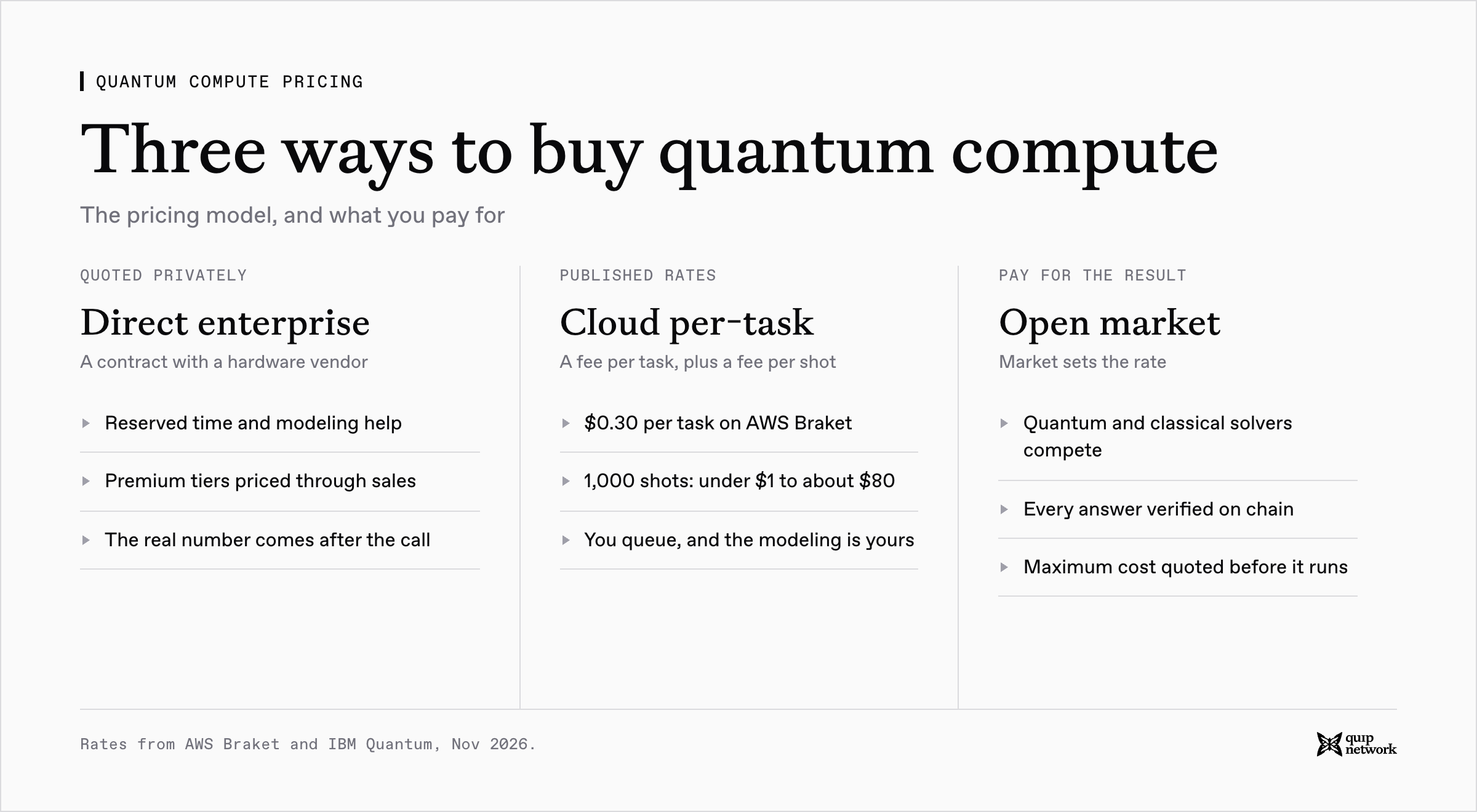
There are three ways to buy quantum compute today.
- Direct enterprise access, where a hardware vendor quotes you privately.
- Cloud per-task billing, where the rates are published and a small job can cost under a dollar.
- And open-market pricing, where hardware competes for your job and the market sets the rate, which is the model Quip Network runs.
Direct enterprise access
The traditional route is a contract with a hardware provider: reserved machine time, help modeling your problem, and someone who knows the machine. D-Wave’s commercial Leap plans and IBM’s dedicated On-Prem system are quoted rather than listed. Some direct access is published (IBM lists pay-as-you-go at $96 a minute), but the premium tiers, the ones with reserved capacity and hands-on support, still run through sales. That is the part worth naming plainly. When pricing is private, the people who learn the real number are the ones already far enough into a sales process to ask.
Cloud per-task billing
The major clouds resell quantum hardware at published rates. AWS Braket charges a flat $0.30 per quantum task plus a per-shot rate that varies by machine, from $0.000425 per shot on Rigetti's Cepheus up to $0.08 per shot on IonQ's Forte. A 1,000-shot job on the cheapest hardware costs under a dollar. The same job on the most expensive machine on that list costs about $80.
Two caveats come with that. You queue behind other users, and the modeling work, turning a business problem into something the machine accepts, is yours to do. The meter runs whether the answer is good or useless.
Open-market pricing
The third model changes what you are paying for, and it is what Quip Network is building. A buyer posts an optimization job with a reward attached, and compute providers, quantum and classical, compete to return the best answer. The chain verifies every submission, and payment goes to the result rather than to reserved machine time. The maximum cost is quoted before anything runs, so you see the price before you spend.
It runs today on the Aglais testnet, with free compute credits for new users. At mainnet, jobs will be priced in QUIP. We walked through the full workflow in "You can run a job on a quantum computer this week".
The reason classical solvers are allowed to compete matters more than it seems. If quantum hardware only wins a job when it returns a better answer for the price, the market builds a public record of where quantum advantage holds up and where it doesn’t.
Where to start
Modeling costs nothing with Quip Network. The open-source tooling runs on your own machine against a classical solver, so you can build and test the problem before spending anything on hardware. Get started at developers.quip.network.