There is a specific, checkable fact about your crypto wallet that most people have never looked up: whether its public key is visible on chain. That one detail determines whether your funds are in the blast radius of the first cryptographically relevant quantum computer, and checking it takes seconds.
The short version
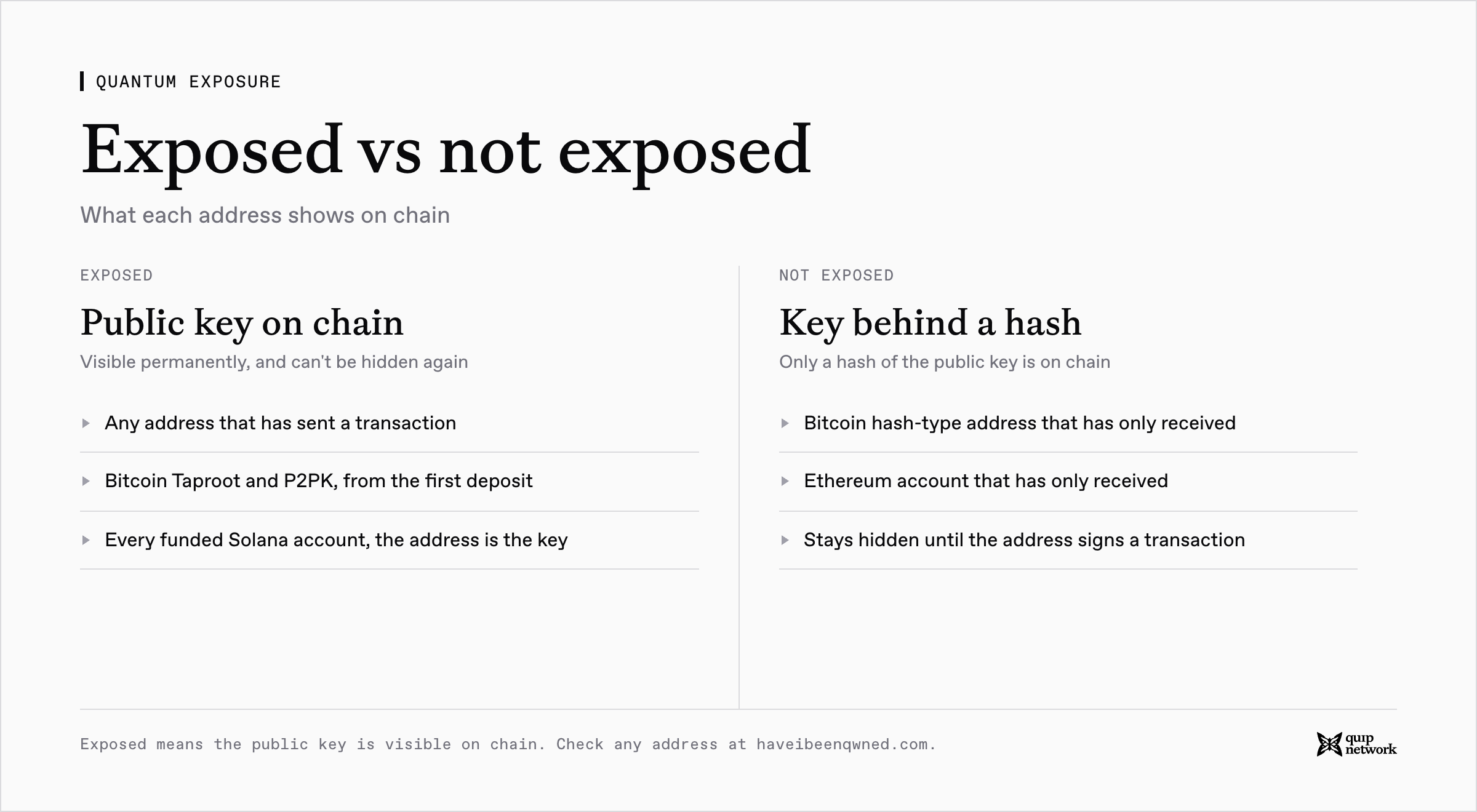
Quantum computers will eventually break the elliptic-curve signatures that guard crypto. They can only break what they can see, and on Ethereum, and most Bitcoin address types, an address reveals its public key the first time it signs. Addresses that have never sent funds keep their key hidden behind a hash. Addresses that have sent even once are exposed, and store now, decrypt later means that exposure is being recorded today for cracking whenever the machine arrives. We built a free checker at haveibeenqwned.com that tells you which side of that line each of your addresses sits on.
What "exposed" actually means
Most Bitcoin addresses, and all Ethereum account addresses, are hashes of public keys. As long as a hashed address only receives, the key itself stays hidden, and even a quantum computer has nothing to attack. The moment an address signs its first outgoing transaction, the public key lands on chain permanently. Shor's algorithm, on a large enough gate-model machine, derives the private key from that public key. About 6 million BTC, roughly 30% of supply, already sits behind exposed keys. That includes most Satoshi-era coins, which were paid straight to a public key, and anything still held in an address you have spent from.
Ethereum accounts expose their key on first transaction too, and address reuse is the norm there rather than the exception, so the exposed share of Ethereum is structurally higher. One 2026 analysis puts 50–65% of all Ether in accounts whose key is exposed.
Some chains don’t put a hash in front of the key at all. Solana addresses are Ed25519 public keys directly, so a Solana address is exposed from the moment it exists, whether or not it has ever signed anything. Bitcoin’s Taproot addresses (starting “bc1p”) work the same way: the key is on chain from the first deposit. The checker covers Bitcoin, Ethereum and other EVM chains, and Solana.
Why this matters before the machine exists
The attack doesn’t need to start today. Exposed keys stay public forever, so they can be cracked whenever hardware catches up. The Global Risk Institute's annual survey of quantum researchers puts meaningful probability in the 2030s, and the NSA's CNSA 2.0 guidance has most national security equipment using only post-quantum algorithms by 2033, with every national security system required to be quantum-resistant by 2035. Governments do not schedule migrations of that size against a threat they think is fictional. For assets you plan to hold for years, the relevant date is the day your key became public, and for any address that has spent, that date has already passed.
What to do with your result
If your address comes back clean, keep it that way. Stop reusing addresses, and let long-term holdings sit in addresses that have never signed.
If your address comes back exposed, the fix is moving the assets behind a post-quantum signature. That is what Quip Accounts do: they hold assets on Ethereum, EVM L2s and Bitcoin L2s behind hash-based signatures paired with the chain's own signature, so the old address’s exposure stops mattering for the assets you’ve moved. There’s no migration to a new network, and swaps between chains run through QuipSwap with both legs protected.
Check your addresses at haveibeenqwned.com. It reads public chain data only, asks for no signatures, and never touches your keys.