Proof of useful work is a way to secure a blockchain where miners compete by solving problems someone actually wants answered, instead of hash puzzles that have no use outside consensus. It aims to keep the security of proof of work, but it only works for problems whose answers are cheap to check, which is why so few chains have pulled it off.
The short version
A blockchain needs a way to decide who produces the next block. Bitcoin does this with proof of work: miners spend computation guessing inputs to SHA-256 until one produces a hash below a target. Once the block is found, every losing guess is thrown away. The puzzles have no use beyond that, and it is the effort itself that secures the chain.
Proof of useful work swaps the guessing game for a real computation and rewards the miner who returns a good-enough answer first. Security still comes from the cost of the work. Quip Network's chain works this way: miners earn the right to produce a block by solving optimization problems, on quantum and classical hardware.
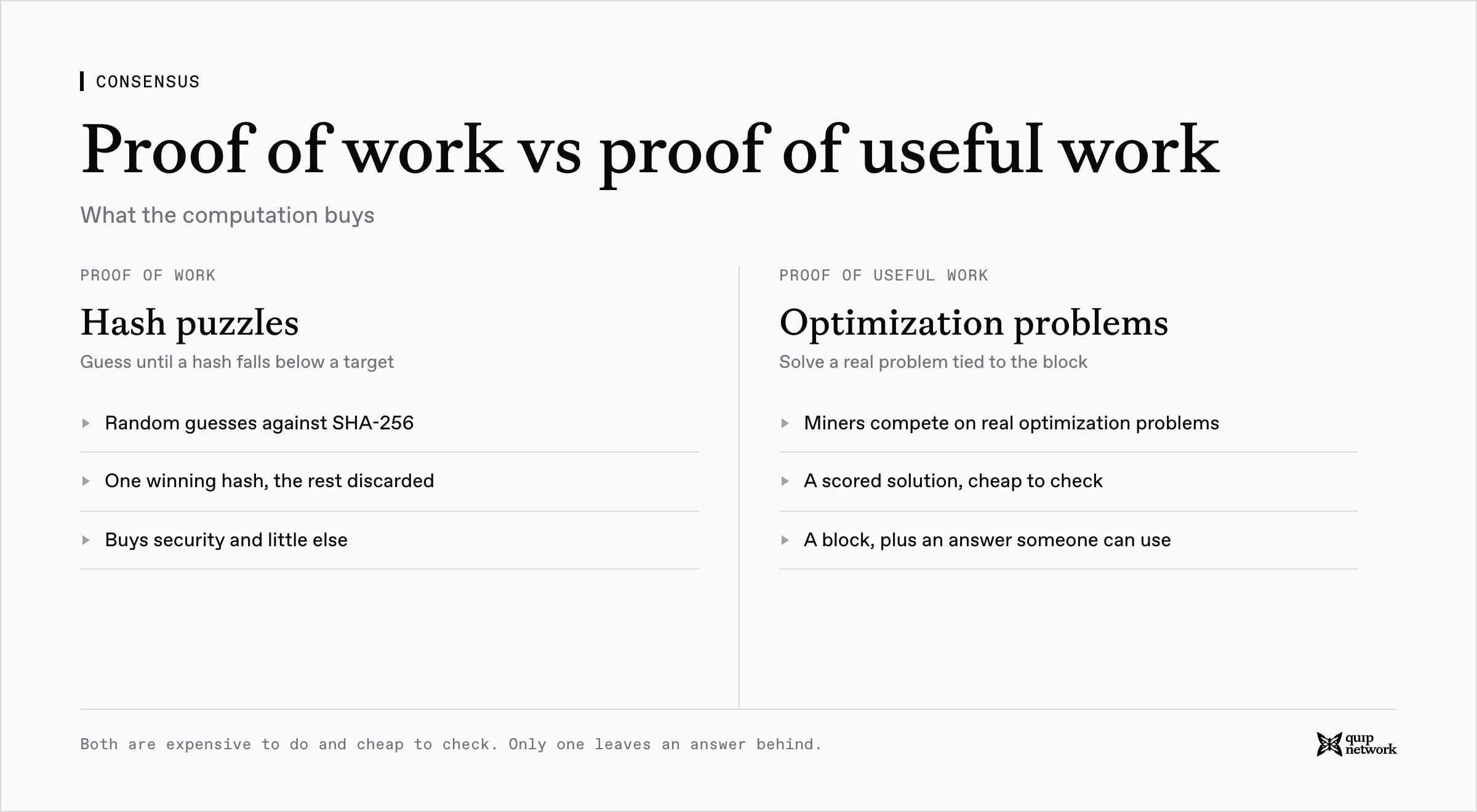
How it compares to proof of work
Both rest on the same asymmetry: the work is expensive to do and cheap to check. That is what lets thousands of strangers agree on one chain without trusting each other.
Proof of work. Checking a hash takes one computation, so anyone can verify a block in a fraction of a second. Each puzzle depends on the previous block, which stops miners from preparing answers in advance. The tradeoff is that all of that computation buys security and little else.
Proof of useful work. The puzzle is a real task, so the same computation does two jobs. The work that secures the network is work someone actually wanted done. The tradeoff is that most useful tasks are hard to check. Verifying a trained AI model usually means rerunning it, which throws away the savings. The task also has to be tied to the block, or a miner could reuse an old answer or pick an easy instance.
Why it took so long
The idea is older than Bitcoin. Cynthia Dwork and Moni Naor introduced proofs of work in 1992 and wrote that it would be better if the work served some other purpose. Vitalik Buterin called a useful, easily verifiable proof of work "probably not feasible" in 2019, and the authors of a 2025 paper on useful work credit that doubt as a large part of why Ethereum moved to proof of stake.
Working designs have mostly picked math problems. Primecoin, launched in 2013, mines chains of prime numbers. A survey of useful-work designs found verification was the weakness they shared, and that math problems with fast checks fit best.
How Quip Network does it
Quip Network's proof of useful work is finding the ground state energy of an Ising model: the lowest-energy arrangement of a set of interacting spins. More than 100 industrial problems map onto it, from routing to job scheduling.
What makes this practical is verification. Most useful work requires redoing the whole job to confirm the result, but optimization is different. A proposed solution is cheap to check even when it was expensive to find, so the network can confirm answers quickly without re-spending the compute it was trying to save.
Each block's problem is derived from that block's header, which ties the work to the block so a miner can't reuse an old answer. CPUs, GPUs and D-Wave quantum annealers all mine, so the chain is designed to build a public record of which hardware wins, much like our annealer-versus-classical results. At mainnet, the winning miner will earn the block reward plus job fees, and the developer whose algorithm ran will earn a royalty.
Where to start
If you have hardware, you can mine on testnet today with a CPU, a GPU or a quantum processor. The node setup guide covers it. If you have an optimization problem, new users get free compute credits on the Aglais testnet. Start at developers.quip.network.