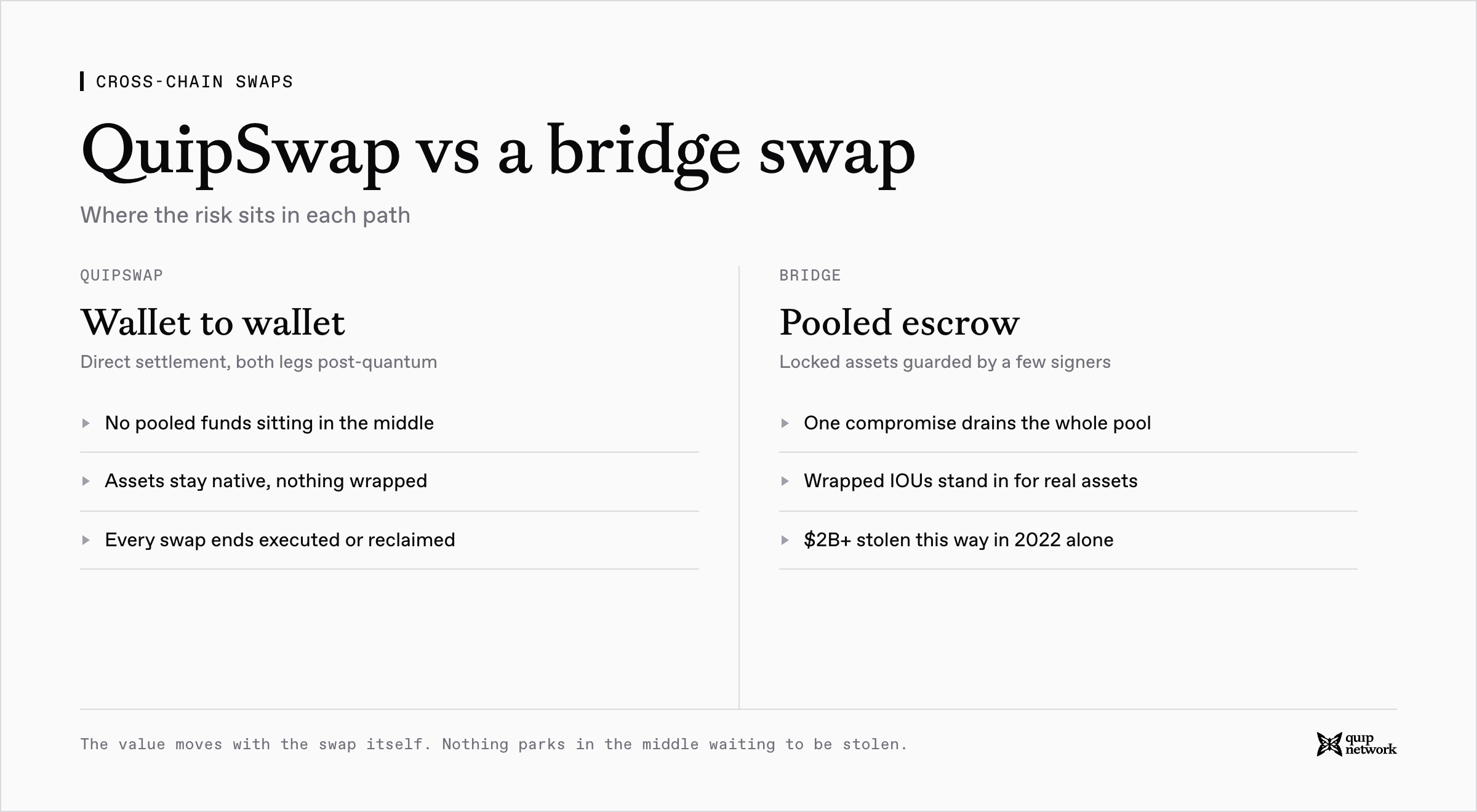
Cross-chain bridge hacks cost users more than $2 billion in 2022 alone, according to Chainalysis. Ronin lost $625 million. Wormhole lost over $320 million. Nomad lost $190 million in one evening, drained by copy-paste attackers who needed no special skills once the first person found the hole.
The pattern is always the same: a bridge holds a pile of locked assets, a small set of signers guards the pile, and sooner or later someone gets past the guards.
The short version
QuipSwap settles a trade directly between two wallets, across two chains, with no bridge, no oracle, and no wrapped asset in the path. Swaps can be made with any combination of native coins, ERC-20, ERC-721, and ERC-1155 tokens on either side of the trade.
One shared secret settles both sides of a trade, or neither. Because that works across chains, value can move without a bridge. There is no pile to rob.
QuipSwap has been audited by Oak Security, and every finding is public.
QuipSwap is a bridgeless cross-chain swap protocol. One party names what they will pay and what they want, along with the chain each leg settles on. Another party takes that offer. The two sides then exchange access to each other's side of the trade directly, with nothing holding either leg in between.
A trade made peer to peer still needs a counterparty, so every open offer sits on a public orderbook. Each row carries both legs with the chain each one settles on, the rate, how that rate compares with the market price, the maker's settle history and when the listing expires. A price index alongside the book covers every asset on it, so whether a given offer is a good deal is answerable from the row itself.
Taking an offer needs a Quip account, which is Quip Network's post-quantum wallet: a wallet whose spending authority is committed to a hash-based signature scheme that a quantum computer cannot shortcut.
How a cross-chain swap works with no intermediary
QuipSwap settles a trade directly between two people, on any two chains, in three steps:
Commit. Each side locks their own assets into a settlement contract on their own chain. The contract records the terms of the trade and a hash of a secret. The deposit kicks off a series of timers.
Execute. One side reveals the secret to claim what they are owed. The reveal is public, so the other side reads the same secret and claims on their chain.
Reclaim. If the deadline passes and nobody executes, each side takes back exactly what they put in.
A swap ends in one of two states. Executed, or reclaimed. A bridge holds your asset in a pool and issues a wrapped claim against it, which makes the pool worth attacking. With QuipSwap, custody never moves and there is no shared pool sitting around for someone to drain.
Authorization works differently too. Most crypto today proves ownership with elliptic-curve signatures, the kind a large enough quantum computer will eventually be able to break. QuipSwap authorizes transactions with hash-based post-quantum signatures instead. The result is quantum-resistant trades.
Note: The QuipSwap settlement contract is gated: only Quip wallet contracts can initiate a swap. Users can create a Quip account to start swapping.
The public audit
QuipSwap is audited by Oak Security, whose final report was published on September 24, 2026. Oak’s audit scope covered swap contracts, the hash-based signature verifier stack, and the smart-account suite.
Every finding is publicly available on GitHub, with each severity rating, the affected code, and recommended fix. The main takeaway: there were no critical issues requiring a redesign, with nearly all major and minor findings resolved.
You can read every finding in the full Oak Security audit report.
Alongside the audit, QuipSwap’s protocol logic is modeled in EasyCrypt, a formal verification framework. Machine-checked theorems establish two valid protocol terminal states: an honest swap completes successfully, while an abandoned swap results in a refund. The game-based proofs establish that under explicitly defined authorization and timing conditions, every honest execution of the protocol reaches exactly one of these two outcomes.
Formal proofs do not replace reading the contracts, which is why we did both.
From swaps to the Quip Network
Alongside QuipSwap’s post-quantum swaps, a Quip account holds post-quantum protected assets on the chains it supports and authorizes swaps against them.
Quip Network is a quantum computing network, able to solve hard problems across finance, manufacturing, logistics, and more. The network forms a unified quantum cloud that connects quantum and classical compute providers with the people who need them.
Discover the whole story at developers.quip.network, try it from swap.quip.network, and read the audit findings yourself in the report above. If you find something the auditors missed, tell us.