


Key Takeaways
- › Quip Network testnet is live and publicly accessible, with more than 13,000 signups ahead of launch
- › Both quantum and classical hardware operators of all types (CPUs, GPUs, QPUs) can participate and earn rewards
- › The codebase is open source
- › Quantum-resistant wallets are live on EVM and Solana, with Bitcoin and other network support in development
The first distributed quantum compute network, combining quantum and classical hardware in a single trustless marketplace, is now open for public testing. The first quantum subnet was built in close collaboration with D-Wave, the world's leading quantum computing company. Run a node, submit optimization workloads to real quantum hardware, or verify solutions with your existing CPU or GPU.
What is Quip Network
Quip Network, built by Postquant Labs, is a trustless marketplace for quantum computing and a post-quantum security layer for existing blockchains. Both quantum and classical hardware operators can participate in the network and earn rewards, and users can submit workloads without needing to own, operate, or understand quantum hardware.
Why we built Quip Network
Quantum computers are starting to demonstrate competitive performance on optimization problems in finance, logistics, and manufacturing, but most of the world can't access that capability yet. The hardware is expensive, difficult to use without domain expertise, and must be reserved in advance with long contracts.
The demand is there. Over half of business leaders surveyed by D-Wave plan to integrate quantum computing into their workflows, but most of them don't have a practical way to start.
53%
of business leaders plan to integrate quantum computing into their workflows, but most don't have a practical way to start.
Source: D-Wave
There's no equivalent of spinning up an on-demand cloud instance for quantum compute.
We built Quip Network to close that gap. Instead of buying hardware or negotiating access through a vendor, you submit a workload to the network and get a result. Quantum providers contribute excess capacity, classical operators help secure the network, and the whole thing runs on open infrastructure that anyone can participate in.
Quip Network architecture
The network has two layers that can be used together or independently.
1) Compute layer: A decentralized marketplace where quantum providers with excess capacity make that compute available to anyone who wants to use it. Consumers submit workloads to application and algorithm developers, and those jobs flow to compute providers running QPUs, GPUs, and CPUs on multiple proof-of-work subnets. Early use cases include optimization problems in finance, logistics, and manufacturing. Operators earn QUIP tokens for solving and verifying results.
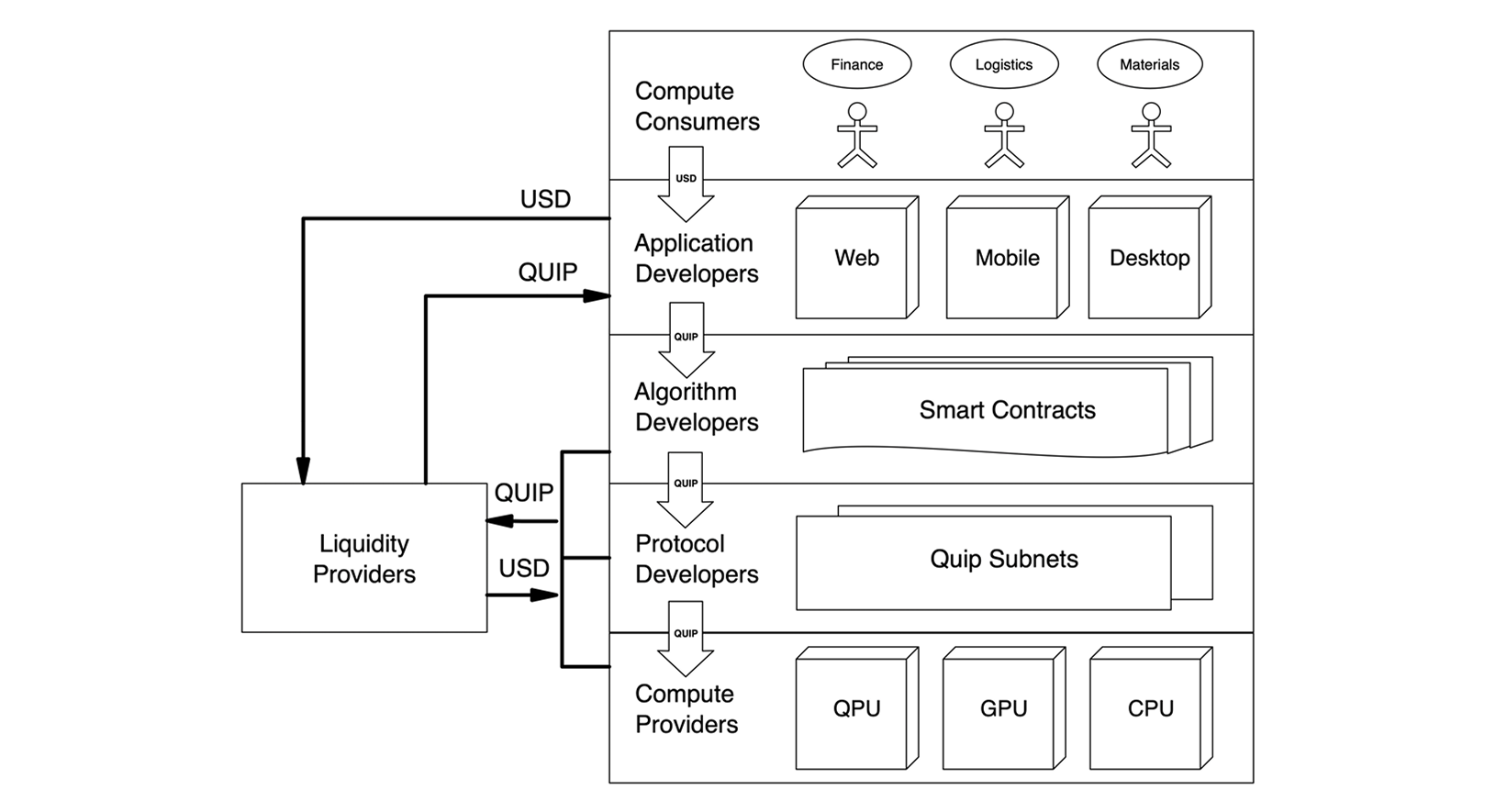
2) Asset layer: A post-quantum security wrapper you can deploy on any existing blockchain. Lock, transfer, or swap assets using quantum-resistant cryptography without bridges or oracles, and without migrating to a new chain. Wallets are already live on EVM and Solana, with Bitcoin support in development.
Both layers will share the same validator economy and a single native token, QUIP. On the compute layer, consumers will pay QUIP to submit jobs, miners will earn QUIP through block rewards and job fees, and validators will stake QUIP to finalize blocks. On the asset layer, users will pay QUIP fees to create wallets, transfer assets, and execute swaps.
The optimization subnet
The first quantum subnet focuses on optimization problems, the kind that appear across finance, logistics, and manufacturing. It runs on annealing QPUs and has demonstrated competitive performance on solution quality, speed, and energy cost relative to classical computing approaches.
The network's incentive model rewards both quantum operators who solve problems and classical operators who confirm correctness. This is the mechanism we're stress-testing with the community before a broader launch later this year.
Open-source and open to everyone
The codebase is open source because we think quantum advantage should be a verifiable result, not a marketing claim. We want the community running nodes, hardening infrastructure, and challenging our implementations with their own hardware.
Join the Testnet
Documentation and node setup guides are available on Gitbook. The codebase is open-source on GitHub.
FAQ
What is Quip Network? +
Quip Network is a distributed quantum compute network and post-quantum security layer. Quantum operators contribute compute power, classical operators verify solutions, and users submit workloads through a trustless marketplace. The network also provides quantum-resistant wallets for securing assets on existing blockchains.
What is the Quip Network testnet? +
The testnet is a public testing environment where researchers, developers, and node operators can experiment with both quantum and classical computing on the network before the full launch. The first quantum subnet runs optimization workloads on annealing QPUs.
Do I need a quantum computer to participate? +
No. Classical hardware like CPUs and GPUs can compete to solve optimization jobs, validate transactions, and verify quantum solutions, all for QUIP token rewards.
What is the QUIP token? +
QUIP is the native token used across both layers of the network. Compute consumers will pay QUIP to submit jobs, miners and validators will earn QUIP for solving jobs and securing the network, and asset layer users will pay QUIP fees for wallet operations and swaps.
What problems can quantum computing solve? +
Quantum computers are well suited for optimization, simulation, and search problems that are difficult for classical hardware. The first Quip Network subnet focuses on optimization, running on annealing quantum processors that have shown performance advantages over classical approaches. These problems appear across finance, logistics, and manufacturing.
What is post-quantum security? +
Post-quantum security refers to cryptographic methods designed to resist attacks from quantum computers. Quip Network uses hash-based signatures (WOTS+) to protect assets on existing blockchains without requiring users to migrate to a new chain.
What chains do Quip Network's quantum-resistant wallets support? +
Quantum-resistant wallets are live on EVM-compatible chains and Solana, with Bitcoin and other network support in development.
Is Quip Network open source? +
Yes. The codebase is publicly available on GitHub.
Who is Postquant Labs? +
Postquant Labs is the company building Quip Network, based in Casper, Wyoming.